 England
Football Online England
Football Online |
|
Players
Index |
Page Last Updated
4 August 2022 |

|
|
| |
|
|
|
|
|
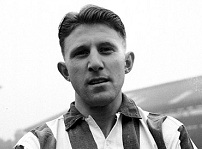
Ray
Barlow |
West Bromwich Albion
FC
1 appearance, 0 goals
P 1 W 1 D 0 L 0 F
2:
A 0
100% successful
1951-58
captain: none
minutes played: 90 |
 |
|
Timeline |
| |
Raymond John Barlow |
|
Birth |
17 August 1926 in Swindon, Wiltshire [registered
in
Swindon, September 1926].
Attended Sandford Street School,
Swindon |
|
Marriage |
to Beryl Austin [registered
in
Rowley Regis, December 1955]. Beryl died in Dudley, 2008. |
|
Death |
14 March 2012 in Bridgend, Glamorgan, Wales,
aged 85 years 210 days |
|
Source |
 Douglas Lammings' An
English Football Internationalist Who's Who [1990] & Douglas Lammings' An
English Football Internationalist Who's Who [1990] & |
|
Club Career |
|
Club(s) |
Began his
football career as a schoolboy in Swindon. He played for Garrard's FC of
Swindon before joining West Bromwich Albion FC as an amateur in June 1944,
turning professional five months later. After
403 league appearances, in which he scored 31 times, Barlow joined
Birmingham City FC, initially on a month's trial, in August 1960, retiring
the following March after just five league appearances.
He was however, permitted to play for Stourbridge FC for a further season,
finally hanging up his boots in the summer of 1962. |
|
Club honours |
FA Cup winners
1953-54; |
|
Individual honours |
Football League
(four appearances) |
|
Distinctions |
None |
|
Height/Weight |
6' 0", 13st.
6lbs [1957]. |
|
Source |
Douglas Lammings' An English
Football Internationalist Who's Who [1990]. |
|
England Career |
|
Player number |
One of
eight who became the 734th
player (737) to appear for England. |
|
Position(s) |
Left half-back |
|
Only match |
No. 291, 2 October 1954,
Northern Ireland 0 England 2, a British Championship match at Windsor Park, Donegall Avenue, Belfast, aged 28 years 46 days. |
|
Major tournaments |
World Cup Finals
1958 (provisional squad); British
Championship 1954-55; |
|
Team honours |
British
Championship winners 1954-55; |
|
Individual honours |
England B
(two appearances, one goal, 1952-53) |
|
Distinctions |
Only the third
Wiltshirian to represent England |
|
Beyond England |
|
A devoted family man, he went on to
run a tobacconist's and sweetshop in West Bromwich, then a post office in
Stourbridge, always retaining his connection with the club he had served
with such distinction and which accorded him a signal honour during its
125th anniversary celebrations in 2004, when he was included in Albion's
all-time 16-man squad. -
The Independent Obituary, 14 March 2012. |
|
The Numbers |
|
parties |
Appearances |
comp. apps |
reserve/
unused |
minutes |
 |
captain |
|
10 |
1 |
1 |
14 |
90 |
0 |
none |
|
minutes are an approximation, due to the fact that many matches rarely stick to exactly ninety minutes long, allowing time for injuries and errors. |
|
P |
W |
D |
L |
F |
A |
GD |
FTS
|
CS |
FAv |
AAv |
Pts% |
W/L |
|
1 |
1 |
0 |
0 |
2 |
0 |
+2 |
0 |
1 |
2 |
0 |
100 |
+1 |
|
his only match was played at an away venue, it was a British
Championship match, and played in a white shirt |
Tournament Record
|
British Championship |
|
Type |
P |
W |
D |
L |
F |
A |
GD |
FTS |
CS |
FAv |
AAv |
Pts% |
W/L |
|
BC 1954-55 |
1 |
1 |
0 |
0 |
2 |
0 |
+2 |
0 |
1 |
2.00 |
0.00 |
100.0 |
+1 |
|
BC All |
1 |
1 |
0 |
0 |
2 |
0 |
+2 |
0 |
1 |
2.00 |
0.00 |
100.0 |
+1 |
|
All Competition |
|
Type |
P |
W |
D |
L |
F |
A |
GD |
FTS |
CS |
FAv |
AAv |
Pts% |
W/L |
|
BC |
1 |
1 |
0 |
0 |
2 |
0 |
+2 |
0 |
1 |
2.00 |
0.00 |
100.0 |
+1 |
|
1 |
1 |
0 |
0 |
2 |
0 |
+2 |
0 |
1 |
2.00 |
0.00 |
100.0 |
+1 |
Match History
|
apps |
match |
pic |
match details |
comp |
res. |
rundown |
shirt |
|
England's selectors announced their forty-man squad from whom the final
22 would be selected, on April 22 1958.
Of the 18 players who were cut from the squad on 28 May, they included
Ray Barlow. |
|
|
|
cg |
|