|
|
|
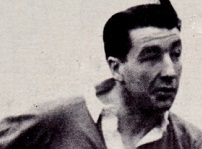
Henry
Cockburn |
Manchester United
FC
13 appearances, 0 goals
P 13 W 9 D 2 L 2 F 40:
A 15
77% successful
1946-51
captain: none
minutes played: 1170 |
 |
|
Timeline |
| |
Henry Cockburn |
|
Birth |
14 September
1921 at 7 Lees Fold, Hurst, Ashton, Lancashire [registered in
Ashton-under-Lyne, December 1921].
Attended Stamford
High School |
|
Baptism |
5 October 1921 at St. John the
Evangelist Church, Hurst, Lancashire. To John Cooper and
Elizabeth (née Delaney). Living at 7 Lees Fold, Hurst. Baptism by
R.W. Cummings |
|
Marriage |
to Anne E.
Newell
[registered in Peterborough, March 1958]. |
|
Death |
20 January 2004 in
Mossley, aged
82 years
128 days
[registered in Tameside, January 2004]. |
|
|
There appears to
be a dispute over Cockburn's death, as there was over his birth (Once
thought to have been born in 1923 - but registration, both birth and
death, state 1921). Many sources claim he died 2nd or 4th February.
But his death was registered in the January.
A memorial was held on 20
January 2014 in Ashton-under-Lyme... ten years after his death. |
|
Source |
 Douglas Lammings' An
English Football Internationalist Who's Who [1990] & Douglas Lammings' An
English Football Internationalist Who's Who [1990] & |
|
Club Career |
|
Club(s) |
"Cockburn, a natural all-round sportsman who also excelled
at cricket, made his first footballing impact as a teenager with Goslings, a
local feeder to Manchester United, the Old Trafford club enlisting him as an
amateur in September 1943. While continuing with his work as a mill- fitter, he
impressed the Reds' coaching staff enough to earn a professional contract a year
later and he made his first United appearance as a nippy, elusive forward during
unofficial wartime competition, in which he had guested also for Accrington
Stanley." |
| |
Then, unlike Neil Franklin, and many more of his peers,
Cockburn turned down a move to Independiente Santa Fe of Bogota on 13
July 1950, who were offering him £5090 per year. Cockburn made 243 First Division appearances, in which he scored four goals. |
| |
Still hardly a gnarled veteran at the age of 30, Cockburn
was not content with life in United's reserves and on 18 October 1954 he accepted a £3000
transfer to Second Division Bury, where he linked up once more with the former
Red Devil Stan Pearson, the deliciously gifted inside-forward behind whom he had
performed so superbly for so long. At Gigg Lane he added 39 League and FA Cup
appearances to the 275 he had accumulated at Old Trafford, then switched to
Peterborough United, at the time plying their trade in the Midland League, in
the summer of 1956. |
| |
he made a final 39 league
appearances, scoring once, before moving on to non-league Corby Town FC in
July 1959 and then played alongside Franklin once more, at Sankey's FC of
Wellington, for six months towards the end of 1960; |
|
Club honours |
Football League
Division One runners-up 1946-47, 1947-48, 1948-49,
1950-51,
Champions 1951-52;
FA Cup winners 1947-48;
FA Charity Shield runners-up 1948, winners 1952; |
|
Individual honours |
Football
League (one appearance) |
|
Distinctions |
Played for
Ashton CC during the 1960's |
|
Height/Weight |
5'
6", 10st.
4lbs [1950]. |
|
Source |
Douglas Lammings' An English
Football Internationalist Who's Who [1990]. |
|
England Career |
|
Player number |
One of nine who
became the 655th
player (660) to appear for England. |
|
Position(s) |
Left-half |
|
First match |
No. 227, 28 September 1946, Ireland 2 England
7, a British Championship match at
Windsor Park, Donegall Avenue, Belfast, aged 25 years
14 days. |
|
Last match |
No. 265, 3 October 1951, England 2 France 2,
a friendly match at Arsenal Stadium, Highbury, London, aged 30 years
19 days. |
|
Major tournaments |
World Cup
Finals 1950; British Championship 1946-47,
1947-48, 1948-49; |
|
Team honours |
British Championship 1946-47, 1947-48; |
|
Individual honours |
England B
(one appearance, 1949) |
|
Distinctions |
Died fourteen
days after Reg Smith |
|
Beyond England |
Took up coaching roles after he left
the playing field. Oldham Athletic FC's assistant trainer from February
1961. Took up a similar appointment at Huddersfield Town AFC from
September 1964. He was their senior coach from 1969 until 1975. -
An English Football Internationalists' Who's Who.
Douglas Lamming (1990). Hatton Press, p.69/70.
Cockburn adored playing football so much that he was eager
to continue, even at lesser levels, later assisting Corby Town and Sankeys of
Wellington before being attracted back to the Football League by another former
United chum, the Oldham Athletic manager Jack Rowley, as a trainer at Boundary
Park in February 1961. Three years later he signed for Huddersfield Town as
assistant trainer, eventually working under yet another ex-Old Trafford
colleague, Ian Greaves, as senior coach before bowing out of the professional
game in 1975. |
|
The Numbers |
|
parties |
Appearances |
comp. apps |
unused/
reserve |
minutes |
 |
 |
captain |
|
19 |
13 |
5 |
four |
1170 |
0 |
one |
none |
|
minutes are an approximation, due to the fact that many matches rarely stick to exactly ninety minutes long, allowing time for injuries and errors. |
|
P |
W |
D |
L |
F |
A |
GD |
FTS
|
CS |
FAv |
AAv |
Pts% |
W/L |
|
13 |
9 |
2 |
2 |
40 |
15 |
+25 |
1 |
6 |
3.077 |
1.154 |
76.9 |
+7 |
Venue Record
|
Venue |
P |
W |
D |
L |
F |
A |
GD |
FTS
|
CS |
FAv |
AAv |
Pts% |
W/L |
|
Home |
6 |
4 |
1 |
1 |
19 |
8 |
+11 |
0 |
2 |
3.167 |
1.333 |
75.0 |
+3 |
|
Away |
7 |
5 |
1 |
1 |
21 |
7 |
+14 |
1 |
4 |
3.00 |
1.00 |
78.6 |
+4 |
Shirt Record
|
Colour |
P |
W |
D |
L |
F |
A |
GD |
FTS
|
CS |
FAv |
AAv |
Pts% |
W/L |
|
White |
12 |
8 |
2 |
2 |
38 |
14 |
+24 |
1 |
6 |
3.167 |
1.167 |
75.0 |
+6 |
|
Red |
1 |
1 |
0 |
0 |
2 |
1 |
+1 |
0 |
0 |
2.00 |
1.00 |
100.0 |
+1 |
Competition Record
|
Competition |
P |
W |
D |
L |
F |
A |
GD |
FTS |
CS |
FAv |
AAv |
Pts% |
W/L |
|
British Championship |
5 |
4 |
0 |
1 |
19 |
7 |
+12 |
0 |
2 |
3.80 |
1.40 |
80.0 |
+3 |
| Friendly |
8 |
5 |
2 |
1 |
21 |
8 |
+13 |
1 |
4 |
2.625 |
1.00 |
75.0 |
+4 |
Tournament Record
|
World Cup Final Tournaments |
|
Type |
P |
W |
D |
L |
F |
A |
GD |
FTS |
CS |
FAv |
AAv |
Pts% |
W/L |
| WCF 1950 |
0 |
0 |
0 |
0 |
0 |
0 |
=0 |
0 |
0 |
0.00 |
0.00 |
0.0 |
=0 |
|
WCF
All |
0 |
0 |
0 |
0 |
0 |
0 |
=0 |
0 |
0 |
0.00 |
0.00 |
0.0 |
=0 |
|
British Championship Competition |
|
Type |
P |
W |
D |
L |
F |
A |
GD |
FTS |
CS |
FAv |
AAv |
Pts% |
W/L |
|
BC 1946-47 |
2 |
2 |
0 |
0 |
10 |
2 |
+8 |
0 |
1 |
5.00 |
1.00 |
100.0 |
+2 |
|
BC 1947-48 |
1 |
1 |
0 |
0 |
2 |
0 |
+2 |
0 |
1 |
2.00 |
0.00 |
100.0 |
+1 |
|
BC 1948-49 |
2 |
1 |
0 |
1 |
7 |
5 |
+2 |
0 |
0 |
3.50 |
2.50 |
50.0 |
=0 |
|
BC
All |
5 |
4 |
0 |
1 |
19 |
7 |
+12 |
0 |
2 |
3.80 |
1.40 |
80.0 |
+3 |
|
All Competition |
|
Type |
P |
W |
D |
L |
F |
A |
GD |
FTS |
CS |
FAv |
AAv |
Pts% |
W/L |
|
BC |
5 |
4 |
0 |
1 |
19 |
7 |
+12 |
0 |
2 |
3.80 |
1.40 |
80.0 |
+3 |
|
5 |
4 |
0 |
1 |
19 |
7 |
+12 |
0 |
2 |
3.80 |
1.40 |
80.0 |
+3 |
Match History
|
Club:
Manchester United F.C. - 13 full appearances (1170 min) |
manager: Walter
Winterbottom - 13 full appearances (1170 min)x
|
|
apps |
match |
pic |
match details |
comp |
res. |
rundown |
shirt |
|
|