|
Jack Reynolds was creditted with scoring the fifth goal in the
immediate aftermath. However, from 1903, ten years after the match,
Fred Spiksley, with significant witnesses, was then creditted with
the goal, during which time, he himself stated that he had scored it
and the record books followed suit. The momentum of which, shows no
signs of slowing.... |
| England's fifth goal? - Spiksley—What they said..... |
John Bentley
was the Football League President, in his column ten years later, he
wrote: "...we won 5 goals to 2—three coming from Bassett's centres,
which were met by the dashing Spikesley and crashed into goal." -
Daily Express, Thursday, 5 February 1903
"It is just
ten years ago since Fred Spikesley helped England to beat Scotland
at Richmond by five goals to two, his share in that magnificent
victory being three goals shot by him." - Athletic News, Monday, 2 March 1903.
"He was awarded his first international cap in 1893 against
Scotland, at Richmond, and many of us recall how he obtained three
goals in ten minutes against the Scots." -
Athletic News, Monday, 16 March 1903.
Although it was his second appearance
"One of the most remarkable goalscorers in the history of
Association football was Fred Spikelsey. 'The Old Fogey' relates how
Spikesley scored three goals against Scotland in ten minutes."
- The Echo, Saturday, 14 November 1903.
"I have
a remembrance that Spikesley scored three goals against Scotland in
ten minutes." - 'Marcus', Football Post,
Saturday, 21 November 1903.
Recalling three England-Scotland
matches, Billy Bassett wrote in his coulmn regarding the match in
1893: "I could get along at that time, and I kept
swinging the ball across, and either Edgar Chadwick or Fred
Spikesley met it perfectly. Spikesley took three centres in hand and
scored each time, and amid a scene of tremendous excitement England
won by five goals to two." - Aldershot Military
Gazette, Friday, 25 October 1907.
"FOOTBALL
ECHOES—The last occasion upon which England scored five goals was in
1893, at Richmond. Fred Spikesley scored three goals on that
occasion." - Woolwich Herald, Friday, 16 April
1920.
"Somebody was asking Fred Spiksley what he
considers the most brilliant achievement of his career. His answer
was: 'The hat-trick against Scotland at Richmond in 1893.'"
- Grimsby Daily Telegraph, Friday, 7 November 1924
"...and the
grey-beards still talk over the match with Scotland in 1893, in
Glasgow, when England were losing by 3—1 something less than half an
hour from the close, and when Spikesley by his speed and ball
control literally pulled the game back, three goals resulting from
his work, and Scotland, being beaten in the end by 4—3."
- Great Players by 'Historian', Lancashire Daily Post, Saturday, 20
February 1926. I mean - he got the
venue and scorelines wrong.... was 'Historian' mistaken anything else?
"Spiksley's achievements are football history. He got ten
caps for England and did the 'hat-trick' in his first two matches
for his country. He scored three goals in succession in ten minutes
against Scotland in 1893. No other Englishmen has performed the
feat. Imagine a goalscoring record being held by an outside left."
- Charles Eade, Sports Editor, Sunday Express, 16 February
1933.
Fred Spiksley wrote about his own recollections on the match for a
Sunday newspaper forty years later. After describing his first two
goals with articulate precision, he wrote: "I scored
another goal after this, my third, within ten minutes. This is a
feat I am told that has never been equalled by any other player for
England against Scotland." - Sunday Express, 19
March 1933
Sir Frederick Wall, the secretary of the Football Association, was in attendence in
Richmond, and he wrote a piece 'FAMOUS INTERNATIONAL MATCHES' some years later,
where he
wrote: "During this
season of 1892-93, England won her three international matches by
such an aggregate as 17 goals to 3. Now five of these goals were
scored by F. Spikesley, including three in this match at
Richmond...Whenever I saw [Spikesley] he played well, but never
better than at Richmond, for he scored the last three goals in about
ten minutes." -
Sunday People, 16 September 1934.
"Any number of famous players have worn the blue and white
stripes of Sheffield Wednesday. Names that come readily to mind,
however, are those of Fred Spiksley, the famous left winger and the
only man to score a 'hat-trick' against Scotland in international
football." - Halifax Daily Courier, Saturday, 3
November 1934
"Fred Spiksley, the only English player who has scored a
'hat-trick' against Scotland." - Shields Gazette,
Friday, 25 October 1935
"DID YOU KNOW?—That: Fred Spiksley created a record,
still unequalled, when he scored a hat-trick for England against
Scotland in 1893." - Sheerness Guardian, Saturday,
2 October 1937
Bob Alaway attended his first ever
England match in
Richmond, aged nine years, and he had been honorary secretary of
Middlesex Wanderers for fifty years when he spoke with Bernard
McElwaine, when he wrote: "Bob recalls his
first match when, in stiff collar and Eton suit, he saw the great
Fred Spiksley play in an international against Scotland at Richmond
in 1893 and score three goals from the left wing in 10 minutes." -
Daily News, Thursday, 29 January 1948, an excerpt from
Alaway's book 'Football All Round the World.'
"Fred Spiksley scored three goals in ten minutes at Richmondonly
time in history any player has scored three or more goals for
England v. Scotland in International Championship."
- Football Echo, Saturday, 25 March 1950
A few reports, particularly in
Gainsborough, acknowledge the 1893 hat-trick when Dennis Wilshaw
became the second player to score an England hattrick against
Scotland in April 1955, and...
"However, Fred
Spikesley also got an English Cup winner's medal in 1896. That medal
is now in the possession of his nephew, Mr. Fred Spicksley, of
Trinity Street, Gainsborough. Attached to that medal is a gold chain
given to the Gainsborough player for his memorable achievement in
being the first Englishmen to score a 'hat-trick' against Scotland."
- Gainsborough News, Friday, 13 May 1955.
According to Clive Nicholson's
Flying Over an Olive Grove, the medal was stolen and no longer
in existence.
"He [Sidney Dowman, formerly of Ropery Road,
Gainsborough] wants to know (to settle a bet) whether it is true
Fred Spikesley was the first man to score three goals in one match
against Scotland? Yes, he was. The year was 1893. He netted all
three goals from the outside left osition in ten minutes."
- Gainsborough News, Friday, 5 April 1957
"IT's A FACT—Fred left England with this imposing record:-Three goals
in ten minutes for England v. Scotland in 1893." -
Star Green 'un, Saturday, 28 January 1961
"With
Scottish heads dropping, Bassett left Maley trailing yards behind
and delvered a crossfield pass which was picked up by Cotterill.
Running at pace, Cotterill linked with Spiklsey to beat the last
line of the Scottish defence. Spiklsey took aim from distance and
Lindsay could only parry his shot out to Cotterill. Cotterill again
set up Spiksley who from fifteen yards out volleyed home with his
left foot to make it 5-2 on 84 minutes."
- Clive Nicholson, Flying Over an
Olive Grove, pp117, October 2016. |
|
England's fifth goal? - Reynolds—What they said..... (all
within the week!) |
"Spikesley put in a capital
shot, which Cotterill undeavoured to make use of, but could not
reach properly. His attempt sent the ball back to Reynolds, who,
with a long shot taken promptly, scored England's fifth goal."
- The Field, Saturday, 8 April 1893. - How
did this turn into Spikesley claiming the goal more than ten years
later?
"These players kept
up a continued bombardment, and, assisted by Reynolds, made the
success of England assured. Reynolds, with a long shot, scored the
fifth goal for England."
- Sporting Life, Monday, 3 April 1893.
"The fifth goal for England followed soon after from a magnificent
effort by Reynolds, who had the ball passed to him by Chadwick. The
Anglo-Irishman was standing between the 25 and half-way line, and he
steadied himself and took aim at the Scottish goal. The ball went
swift and straight as an arrow, hardly rising more than a foot from
the ground, and fairly beat the Scottish goal-keeper." -
'Olympian', Yarmouth Gazette, Saturday, 8 April 1893
(also in the Bucks Advertiser).
"And still they were
not satisfied, for from a rattling kick by Kinsey, Arnott returned.
Reynolds met it, and drove it home for the fifth timea splendid
shot." -
'The Free Critic,' Athletic News, Monday, 3 April 1893.
although within ten years, the Athletic would change its opinion.
"...and Reynolds with a
magnificent long shot made England's victory doubly sure."
- Sheffield Evening Telegraph, Monday, 3 April 1893.
"...and a few minutes later Chadwick centred splendidly, and
Reynolds, with a long swift shot, secured a fifth goal."
- Morning Post, Monday, 3 April 1893.
"but,
strange to relate, the Scotchmen suddenly collapsed, as in many
minutes Spikelsey had kicked tow more goals, whilst just before the
close Reynolds, with a long shot, added another." -
Evening Standard, Monday, 3 April 1893.
"Reynold's
followed with a fifth." - Dundee
Advertiser, Monday, 3 April 1893.
"It was at this
period anybody's game, but strange to relate the Scotchmen suddenly
collapsed, as in as many minutes, Spikesley had kicked two more
goals, whilst just before the close Reynolds, with a long shot,
added another." - Sheffield Daily
Telegraph, Monday, 3 April 1893.
"Disaster for Scotland did not end here, for a minute or two later
Chadwick and Spikesley came away together, and though Smellie half
saved, Reynolds from 15 yards distant, beat Lindsay with a hard, low
shot." - The Yorkshire Herald, Monday, 3 April 1893. (also in
Alcester Chronicle, Bayswater Chronicle, Bromley Chronicle,
Christchurch Times, Diss Times, Dover Express, Earlstown Guardian,
East & South Devon Advertiser, Eastern Daily Press, Exmouth Journal,
Henley & South Oxford Standard, Hornsea Gazette, Leeds Mercury,
Loftus Advertiser, North Devon Gazette, Nottingham Journal,
Sevenoaks Chronicle, Sheerness Times, Shipley Times, Tenbury Wells
Advertiser, Western Morning News)
"...Chadwick and
Spikesley came away, and though Smellie half cleared, Reynolds, with
a splendid long shot, scored a fifth goal for England amidst
tremendous cheering."
- Liverpool Echo, Monday, 3 April 1893 (also in Dublin
Evening Mail and South Wales Daily News, variation on this in the
Birmingham Daily Post).
"The end of this attack was
a pass by Chadwick to Reynolds, who with a long straight, swift shot
fairly beat Lindsay....The fifth goal was also a very doubtful
point; in fact, a neutral man would never have give it."
- The Scottish Referee, Monday, 3 April 1893.
"Three minutes later Cotterill passed to the right, and Reynolds
took effect with a long shot, and made the score five to two."
- Lloyds Weekly, Sunday, 2 April 1893/Daily Chronicle,
Monday, 3 April 1893.
"...and before the whistle
blew, Reynolds added a fifth." -
Aberdeen Free Press, Monday, 3 April 1893
"The final goal of the match was obtained by Reynolds." -
Louth & North Lincolnshire Advertiser,
Monday/Wednesday, 3/5 April 1893.
"The last three
goals were put on in ten minutes, Spikelsey, the Sheffielder, scored
a couple of them, and did a great deal towards the addition of the
third."
- Rotherham Advertiser, Saturday, 8 April 1893
"The play of England improving, Spikesley shot a couple of goals,
Reynolds adding a fifth." - Penny Illustrated Paper,
Saturday, 8 April 1893.
"The English were not yet
done with yet, for after Arnott had cleared a good shot by Kinsey,
Reynolds sent in a long kick, which Lindsay could not reach, and
England were placed three goals ahead." - Richmond
Herald, Friday, 7 April 1893.
"Again the English
forwards got in front of the Scotch goal, and Cotteril passed back
to Reynolds, who put on the fifth and last goal with a fast shot."
- West Somesert Free Press, Saturday, 8 April 1893.
"Mr. Fred Spiksley, the former
international footballer, was overcome by the heat and fell dead in
Tattersall's enclosure at Goodwood, yesterday. He..scored three goals
in one international match, and played seven times for England."
- Yorkshire Post/Nottingham Journal, Thursday, 29 July 1948
- referring to his hat-trick against Wales? |
|
|
|
|
flg.jpg)  "AN
OFF-SIDE VICTORY"
Scottish Referee "AN
OFF-SIDE VICTORY"
Scottish Referee |
|
 Officials Officials |
England |
Team Records |
Scotland |
Referee
John Charles Clegg
(FA Chairman & Vice-President)
46
(15 June 1850), Sheffield, West Riding of Yorkshire
|
"The match was honoured by HRH The Duchess of Teck
(Princess Mary Adelaide Wilhelmina Elizabeth
of Cambridge, b.1833), the Duke of Teck
(Franz Paul Karl Ludwig Alexander b.1837) and the Princess Mary (Victoria Mary Augusta
Louise Olga Pauline Claudine Agnes, b.1867), [and Prince
Adolphus of Teck (Adolphus Charles Alexander
Albert Edward George Philip Louis Ladislaus of Cambridge, b.1867)]
to whom the captains of the two teams were presented before the game began". |
Linesmen (McGregor replaced T. Gunning, London)
| England (FA
Chairman) |
Scotland (SFA
President) |
|
William McGregor
49
(13 April 1846) Birmingham |
Archibald Sliman
Battlefield, Mount Florida, Glasgow |
|
|
|
|
England
Team |
| |
|
Rank |
No official ranking system established;
ELO rating
1st |
Colours |
"The Englishmen were dressed in white
flannel shirts...." |
Captain |
George
Cotterill |
Selection |
following
the trial match,
The seven-man FA
International Selection Committee |
|
P last of 2, W 2 - D 0 - L 0 - F 11 - A
3. |
P 18 of 195, W 16 - D 1 -
L 1 - F 77 - A
17. |
|
|
team chosen
after the FA Cup Final at Fallowfield on Saturday, 25 March 1893. |
|
England Lineup |
|
|
seven changes to the previous match (Holmes, Reynolds,
Bassett & Spiksley remain) |
league position (25th March) |
ave lge pos:
7th⁷ |
|
24 |
|
Gay, Leslie H. |
22
8 days |
24 March 1871 |
G |
Cambridge University AFC,
Old Brightonians FC
&
Corinthians FC |
1 |
2ᵍᵃ |
|
210 |
|
|
Holmes, Robert |
25
282 days |
23 June 1867 |
RB |
Preston North End FC
(FL1 3rd) |
5 |
0 |
|
|
Harrison, A. Hugh |
23
122 days |
30 November 1869 |
LB |
Old Westminsters
AFC &
Corinthians FC |
2 |
0 |
|
final app
1893 |
|
|
Reynolds, John |
24
39 days |
21 February 1869 |
RHB |
West Bromwich Albion FC
(FL1 11th) |
3 |
1 |
|
|
Holt, John |
26
167 days |
16
October 1866 |
CHB |
Everton FC
(FL1 4th) |
6 |
0 |
|
|
Kinsey,
George |
26
125 days |
27 November 1866 |
LHB |
Wolverhampton Wanderers FC
(FL1 9th) |
2 |
0 |
 |
Bassett,
William I. |
24
64 days |
27 January 1869 |
OR |
West Bromwich Albion FC
(FL1 11th) |
10 |
3 or
4 |
|
|
Chadwick, Edgar W. |
23
291 days |
14 June 1869 |
IR |
Everton FC
(FL1 4th) |
4 |
3 |
 |
Cotterill, George H. |
24
362 days |
4 April 1868 |
CF |
Old Brightonians AFC
&
Corinthians FC |
4 |
2 |
|
final app
1891-93 |
|
|
Gosling, R. Cunliffe |
24
290 days |
15 June 1868 |
IL |
Old Etonians
AFC &
Corinthians FC |
2 |
1 |
|
|
Spiksley, Frederick |
23
66 days |
25 January 1870 |
OL |
Wednesday FC
(FL1 10th) |
2 |
6 |
|
the 32nd brace scored ~
fifteenth hattrick |
|
reserves: |
John Goodall was in attendance, and even made the team photograph. |
|
team changes: |
Bob Howarth (Everton FC
(FL1 4th)) was the original right-back, his place
going to Bob Holmes.
John Goodall (Derby County FC
(FL1 14th)) was replaced with George Cotterill,
who was only called upon because of his proximity to the ground, and
the fact he had a telephone. Goodall had injured himself in a match the previous day. |
|
team notes: |
Jack
Reynolds had already played five times for the Irish team, scoring
once (1890-91 (two appearances and one goal against England)).
Umpire Charlie Clegg also played for England in the
first ever
international, and is the older brother of WIlliam, who appeared
in 1873
and 1879. |
|
appearance notes: |
Billy Bassett is the sixth player to make
ten England appearances, whereas Johnny Holt is the nineteenth
player to make six.
31 players have now made five England appearances and 38 players have now made four.
Jack Reynolds is the sixtieth player to have now made three England
appearances. 111
players have
now played for England more than once.
Bassett is the first player
to make nine appearances under the guidance of the ISC, whereas
Goodall is the second player to make eight. |
|
hattrick notes: |
IF Spiksley scored England's fifth, then he has scored his second hat-trick
for England in his first two appearances. |
|
records: |
England's thirtieth victory in 49 matches. Also their thirtieth
competitive match.
England
extend their record of back-to-back victories, now at nine matches,
and extend their unbeaten record to twelve matches. Their 'Home'
record now stands at six victories in a row.
This is the fourth
time England have won all three games in one season, the only time
they will do it for three consecutive seasons.
The second time
England have scored seventeen goals in a season/year, and they came
from a record-breaking ten different goalscorers.
England have now
scored 174 goals, fifteen have now been equalising goals - but this is
the first time that the second England goal has been the first
equalising goal in the match. |
|
|
|
2-3-5 |
Gay -
Holmes, Harrison -
Reynolds, Holt, Kinsey -
Bassett, Chadwick, Cotterill, Gosling, Spiksley. |
|
Averages: |
Age |
24 years
165 days |
Appearances/Goals |
3.7 |
1.1 |
|
England
previous teams |
|
1892: |
Toone |
Holmes |
Dunn |
Reynolds |
Holt |
Shelton |
Bassett |
Goodall |
Southworth |
Chadwick |
Hodgetts |
|
1893: |
Gay |
Harrison |
Kinsey |
Chadwick |
Cotterill |
Gosling |
Spiksley |
|
|
|
|
Scotland
Team |
| |
|
Rank |
No official ranking system established;
ELO rating
2nd |
Colours |
"...and the Scots were dressed in the customary dark blue
jerseys." |
|
Captain |
Jim Kelly |
Selection |
The Scottish Football Association
Selection Committee, of seven members |
|
P 3 of 5, W 2 - D 0 - L 1 - F 15 - A 8. |
|
|
team chosen at the Alexandra Hotel in Glasgow, on Saturday, 25 March 1893, following
the Scotland vs. Ireland match. |
|
Scotland
Lineup |
|
|
Lindsay, John |
31
75 days |
16 January 1862 |
G |
Renton FC |
3 |
11ᵍᵃ |
|
final app
1888-93 |
|
|
Arnott, Walter |
31
324 days |
12 May 1861 |
RB |
Queen's Park FC |
14 |
0 |
|
mst apps |
|
final app
1883-93 |
|
|
Smellie, Robert |
27
168 days |
22 December 1867 |
LB |
Queen's Park FC |
6 |
0 |
|
final app
1887-93 |
|
|
Mitchell, David |
26
337 days |
29 April 1866 |
RHB |
Rangers FC |
4 |
0 |
|
|
Kelly, James |
28
66 days |
25 January 1865 |
CHB |
The Celtic FC |
7 |
1 |
|
|
Maley, William Patrick |
24
341 days |
25 April 1868 |
LHB |
The Celtic FC |
2 |
0 |
|
final app
1893 |
|
|
Sellar, William |
28
162 days |
21 October 1864 |
OR |
Queen's Park FC |
9 |
4 |
|
final app
1885-93 |
|
|
Waddell, Thomas Smith |
22
143 days |
9 November 1870 |
IR |
Queen's Park FC |
4 |
2 |
|
|
Hamilton, James |
23
284 days |
7 June 1869 |
CF |
Queen's Park FC |
3 |
3 |
|
final app
1892-93 |
|
|
McMahon, Alexander |
23
167 days |
16 October 1870 |
IL |
The Celtic FC |
3 |
1 |
|
|
Campbell, John |
20
225 days |
19 August 1872 |
OL |
The Celtic FC |
2 |
0 |
|
reserves: |
not known |
|
records: |
Scotland's fiftieth match (W 38 -
D 6 - L 6 - F 194 - A 68) |
|
"The majority of the Scottish team left Glasgow as Thursday
evening for the English Metropolis. They were located at the
Caledonian Hotel, London." |
|
|
|
2-3-5 |
Lindsay -
Arnott, Smellie -
Mitchell, Kelly, Maley -
Sellar, Wadell, Hamilton, McMahon, Campbell |
|
Averages: |
Age |
26
years 5 days |
Appearances/Goals |
5.2 |
0.7 |
|
|
|
|
Match Report
Sheffield
Independent, Monday, 3 April 1893 |
|
Favoured
with weather of the most delightful and summer-like description, the
22nd annual contest under Association rules between representative teams
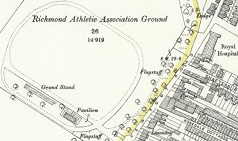
of England and Scotland took place on Saturday at the Athletic Ground,
Richmond. The afternoon, indeed, was really too hot for football, being
more suggestive of August than April, but, though very exhausting
to those who had to play an hour and a half's football at high pressure,
it was greatly appreciated by the thousands of spectators. There was, of
course, a very big crowd present, but probably not more than 20,000, as
was fortunate, for the Athletic Ground at Richmond, admirable enclosure
as it is, is not adapted for the accommodation of anything like an
exceptionally large gathering. The straggle was honoured by the presence
of Royalty in the persons of her Royal Highness the Duchess of Teck, the
Duke of Teck, the Princess May and Prince Adolphis of Teck, and before
the game began the captains of the two elevens were duly presented to
the distinguished party. |
On winning the toss the English captain placed his men with their backs
to the sun, and the moment that Hamilton kicked off the Scotchmen forced
the ball over the line. Then the Englishmen rushed the ball down, and
Cotterill head in. Lindsay stopped the shot, but Cotterill caught the
ball on the rebound, and his second stroke went just outside the post.
On restarting from the goal-kick the visitors broke away, but before
they could become dangerous the pressure was relieved through Campbell's
getting off-side, and following this incident the home side showed to
conspicuous advantage. They attacked repeatedly, and but for a fine bit
of play by Arnott at back, Cotterill would probably have scored early in
the game. The big Corinthian was very carefully watched, and this at
times made him appear not only ineffective, but poor, but with Gosling,
he in the first 20 minutes took the ball into dangerous proximity with
the Scottish goal, and on two occasions he was perhaps unfortunate in
failing to score. In a momentary attack by the visitors they were
assisted by a free kick awarded for a foul, but Smellie kicked too hard,
and Chadwick, getting the ball away, ran it down and passing to Gosling,
the Old Etonian, scored the first goal for England after fifteen
minutes' play. Keeping up the pressure, Cahdwick again made a nice run
and passing to Bassett, the latter sent in a shot which Arnott managed
to half stop, and eventually to clear, but for a log time the Scottish
forwards never had the ball as the play of the half-backs was
magnificent. For pace and clever ness the English forwards easily beat
the Scotch, but near goal they did not shine conspicuously. Gosling,
after a good run, was well placed, but his shot was a poor one, and
Arnott had no difficulty in preventing Chadwick from coming to his
assistance. For nearly half an hour Gay, the English goalkeeper, had
really nothing to do, but at the end of that time the visiting forwards
showed some decided improvement, and in one of their occasional attacks
M'Mahon dropped the ball up slowly to Gay. The shot was a very quiet one
and should have been easily dealt with, but Gay framed very badly at it,
and before he could clear Sellar run up and dashed the ball through, and
so equalised amidst the shouts of delight of the Scottish partisans/
Encouraged by their unexpected success the Scots played up with renewed
vigour, and during the next ten minutes they were constantly in front of
the English goal. The pressure was kept up without intermission, but
only on two occasions did the attack appear really dangerous, and
gradually England got upon terms with their opponents. But by this time
the Combination of the visitors had greatly improved, and the Scottish
half-backs allowed the English forwards but few opportunities of
shooting effectively, and at half-time the score was still ENGLAND
1 goal. SCOTLAND
1 goal.
.jpg) After an interval of ten
minutes Cotterill kicked off, and Spiksley dribbling down, forced a
corner, but the ball was cleared, and after a splendid run Sellar shot
just outside. Scotland directly afterwards had a chance through Gay's
being penalised for running out too far in clearing, but Holt, who
throughout showed capital form, quickly got rid of the ball and relieved
the pressure for a time. It was only momentarily, however, as Scotland
was soon back again, and after some pretty passing Sellar sent in a low
shot which Gay could not reach, and the visitors obtained a tangible
advantage, the second goal being scored within two minutes of the
resumption. Just about this time the English forwards deteriorated very
much and quite lost their combination, Cotterill in the centre being
especially weak, but the half-backs maintained their good form. After a
short attack by the English forwards Scotland broke away and forced a
corner. This was at once cleared, and in turn Spiksley compelled one of
his opponents to put the ball behind, and after a good centre and a long
and exciting bully, Cotterill succeeded in driving the ball through,
England thus equalising at the end of 15 minutes. Having once again
placed themselves upon level terms, the English team showed a
determination to better their position, and their improvement was
wonderful. The half-backs persistently fed Spiksley and Chadwick, and
the pair made the most of their opportunities, as they time after time
carried the ball into dangerous proximity to the Scottish goal. 'Hands'
against Smellie, close to goal, gave England a chance, but the attack
was repulsed. The ball was not allowed to go far up the field, however,
as Bassett raced back with it, and passing across to Spiksley, the
latter shot through, and placed England a goal in front. Almost as soon
as the ball had been restarted the same two players were instrumental in
obtaining the fourth point, as Bassett again crossed to Spiksley, who
dashed up and headed the ball through. With a won game the Englishmen
continued to show grand form and for a time their forwards fairly ran
through the Scottish defence. In an attack Chadwick and Spiksley came
away, and although Smellie half cleared the latter's shot. Reynolds'
returned with a tremendously fast low stroke, which scored the fifth
goal for England, the last three having been obtained in ten minutes. As
the game drew to a close the Scotchmen played up vigorously, but
although Gay was twice called upon to handle the ball away they were not
fortunate enough to score, and England was left with the victory. After an interval of ten
minutes Cotterill kicked off, and Spiksley dribbling down, forced a
corner, but the ball was cleared, and after a splendid run Sellar shot
just outside. Scotland directly afterwards had a chance through Gay's
being penalised for running out too far in clearing, but Holt, who
throughout showed capital form, quickly got rid of the ball and relieved
the pressure for a time. It was only momentarily, however, as Scotland
was soon back again, and after some pretty passing Sellar sent in a low
shot which Gay could not reach, and the visitors obtained a tangible
advantage, the second goal being scored within two minutes of the
resumption. Just about this time the English forwards deteriorated very
much and quite lost their combination, Cotterill in the centre being
especially weak, but the half-backs maintained their good form. After a
short attack by the English forwards Scotland broke away and forced a
corner. This was at once cleared, and in turn Spiksley compelled one of
his opponents to put the ball behind, and after a good centre and a long
and exciting bully, Cotterill succeeded in driving the ball through,
England thus equalising at the end of 15 minutes. Having once again
placed themselves upon level terms, the English team showed a
determination to better their position, and their improvement was
wonderful. The half-backs persistently fed Spiksley and Chadwick, and
the pair made the most of their opportunities, as they time after time
carried the ball into dangerous proximity to the Scottish goal. 'Hands'
against Smellie, close to goal, gave England a chance, but the attack
was repulsed. The ball was not allowed to go far up the field, however,
as Bassett raced back with it, and passing across to Spiksley, the
latter shot through, and placed England a goal in front. Almost as soon
as the ball had been restarted the same two players were instrumental in
obtaining the fourth point, as Bassett again crossed to Spiksley, who
dashed up and headed the ball through. With a won game the Englishmen
continued to show grand form and for a time their forwards fairly ran
through the Scottish defence. In an attack Chadwick and Spiksley came
away, and although Smellie half cleared the latter's shot. Reynolds'
returned with a tremendously fast low stroke, which scored the fifth
goal for England, the last three having been obtained in ten minutes. As
the game drew to a close the Scotchmen played up vigorously, but
although Gay was twice called upon to handle the ball away they were not
fortunate enough to score, and England was left with the victory.
|
|
Match Report
The Times, Monday,
3 April 1893 |
.jpg) The
general estimate of the attendance at the Richmond Athletic Ground on
Saturday, when the 22nd match between England and Scotland took place,
was 20,000. Everything was favourable for the spectators, but the summer
weather could not have been very welcome to the players, who, however,
maintained a fast pace to the end. England were able to claim a decisive
victory after a match in which the tide of success inclined to each side
before finally turning strongly for the home eleven. The nature of the
play kept the spectators at a high pitch of excitement, and the football
seemed thoroughly appreciated. Although the partisan spirit was very
marked among the large company perfect good humour prevailed ; and the
Scottish element, after making much noise in the time that they were
leading, submitted quietly to the banter of the English team's friends
as, within some quarter of an hour to 20 minutes, England recovered
their form and scored four goals. The Duke and Duchess of Teck, Princess
May, and Prince Alexander of Teck witnessed the play from an enclosure
set apart for them in front of the grand stand. In spite of the
well-planned arrangements the spectators crowded in front of the place
occupied by the Press, some of whom must have been greatly hampered in
their work... The
general estimate of the attendance at the Richmond Athletic Ground on
Saturday, when the 22nd match between England and Scotland took place,
was 20,000. Everything was favourable for the spectators, but the summer
weather could not have been very welcome to the players, who, however,
maintained a fast pace to the end. England were able to claim a decisive
victory after a match in which the tide of success inclined to each side
before finally turning strongly for the home eleven. The nature of the
play kept the spectators at a high pitch of excitement, and the football
seemed thoroughly appreciated. Although the partisan spirit was very
marked among the large company perfect good humour prevailed ; and the
Scottish element, after making much noise in the time that they were
leading, submitted quietly to the banter of the English team's friends
as, within some quarter of an hour to 20 minutes, England recovered
their form and scored four goals. The Duke and Duchess of Teck, Princess
May, and Prince Alexander of Teck witnessed the play from an enclosure
set apart for them in front of the grand stand. In spite of the
well-planned arrangements the spectators crowded in front of the place
occupied by the Press, some of whom must have been greatly hampered in
their work...
...Chadwick and Spikesley
brought the ball along the left side, and taking a fine centre from the
former Gosling butted it through. Thus the England team obtained the
opening goal...
...Campbell
and M'Mahon forced the ball close to the home line and it was sent into
the mouth of the goal, and Waddell drive it through...
Ends had
not long been changed when the Scottish again forced the play, and the
outcome of some accurate passing was a goal by Sellar, who had received
the ball from Waddell...
...Following close play near the Scottish posts and a dexterous save by
Lindsay, the ball was returned from the right wing, and Cotterill, amid
loud cheering, brought the figures level...
...but a
few minutes later Bassett and Gosling dribbled down the right side and a
long pass was given to Spikesley, who had got so well forward that a
prompt appeal was made for "off-side," and he scored with a fine shot.
The off-side appeal was over-ruled. Again, England forced the game, the
wing men playing splendidly. Bassett helped Spikesley to get the fourth
goal, and a long kick from the left (by Chadwick) was followed by
Reynolds registering the fifth point with a lofty shot from half-back...
It was
little less than remarkable the style that England half-way through the
second stage managed to renew their combination...
This is
England's third consecutive victory, and they have now won six matches
to Scotland's 11. There have been five drawn matches. |
|
|
|
In Other News....
|
It was on 1 April 1893 that the British
Admiralty sent its congratulations to the Neptune Salvage Company on its
successful re-floating of the battleship HMS Howe after it had run
aground five months earlier whilst attempting to negotiate the narrow
entrance to Ferrol Harbour on the Spanish coast. |
|
|
|
|
Domestic
Football Results (1 April 1893)
Teams in a silver box denotes a player representing England |
The Football
League Division One:
Bolton Wanderers 2 Sunderland
1
Pike's Lane, Bolton
(13,000)
Bentley, Weir ~
Campbell |
|
John Sutcliffe, Davie Weir and Jimmy Turner started for Bolton |
|
Tom Porteous started for Sunderland |
Burnley 2 Wolverhampton
Wanderers 0
Turf Moor, Burnley
(8,000)
Turnbull, nk |
|
Wolves were missing George Kinsey. However,
they started with Billy Rose, Dick Baugh, Harry Allen, George
Woodhall and Harry Wood. |
Everton 4 Blackburn Rovers
0
Goodison Park, Liverpool
(14,000)
James, McMillan, Geary, Maxwell |
|
Everton were without Johnny Holt and Edgar Chadwick, but
did have Bob Howarth and Fred Geary |
|
Nat Walton, Jimmy Forrest and Jack Southworth started for Rovers |
Newton Heath 2 Preston North
End 1
North Road, Manchester
(9,000)
Donaldson (2) ~
Stewart |
|
Preston were
without Bob Holmes |
Wednesday 0
Stoke 1
Olive Grove,
Sheffield
(5,000)
Dixon |
|
Wednesday were without Fred Spiksley,
but did have Billy Betts |
|
Stoke started with Bill Rowley, Tommy Clare and Joe
Schofield |
West Bromwich Albion 3
Derby County 1
Stoney Lane, West Bromwich
(3,655)
T.Perry, Geddes, C.Perry
~ A.Goodall |
|
West Brom were without Billy Bassett
and Jack Reynolds, but did start with Joe Reader and Tom & Charlie
Perry. |
|
County started with Jack Robinson, Jack Cox, Fred Forman and
Steve Bloomer |
|
|
Preston's hopes of
reclaiming the title for the third time in five years were all but
over following a shock defeat at Newton Heath, who were already
destined for the test matches where they would successfully retain
their First Division status. Although Sunderland only needed one
more point, Preston faltered again, two days later, on Easter
Monday, by failing to beat Accrington, and the so-called 'team of
all talents' retained the Championship, emulating Preston's
achievement of three years earlier.
|
|
|
|
|
|
|
|
|
The Football
League Division Two:
Burton Swifts 0 Sheffield United 3
Peel Croft,
Burton
(3,000)
Hill, Waller, Gallacher |
|
United started with Mick Whitham |
Grimsby Town 3 Walsall Town Swifts 0
Abbey Park,
Grimsby
(1,000)
Higgins (2),
Ackroyd |
Lincoln City 5 Bootle 1
John O'Gaunt's,
Lincoln
(2,000)
Raby (2), Smallman (2),
Roberts ~ nk |
|
|
Small Heath 3 Ardwick 2
Coventry Road,
Birmingham
(1,000)
Hallam (2), Walton ~
Yates, Carson |
|
Chris Charsley started for Heath |
Small
Heath completed their league fixtures with a ninth successive victory,
but it was another two weeks before they could claim to be champions,
and they then lost their test match to Newton Heath, thus failing to win
promotion, with Darwen and Sheffield United both successful.
|
|
|
|
|
|
|
|
|
|
|
|
|
Source Notes |
TheFA
Scottish FA
Cris Freddi's England Football Factbook
ScottishSportHistory: Andy Mitchell |
|
LondonHearts.com
The Football Association Yearbook
Richard Keir's Complete International
Record of Scotland
Original Newspaper Reports
Flying Over an
Olive Grove - Clive Nicholson, pp.111-121. |
|
|
cgi |
|
 England
Football Online
England
Football Online


.jpg)