|
|
 |
 P 8 W 5 D 2 L 1
F 17:A 6 P 8 W 5 D 2 L 1
F 17:A 6
75% successful

  |
|
Description |
 |
 |
 |
 |
|
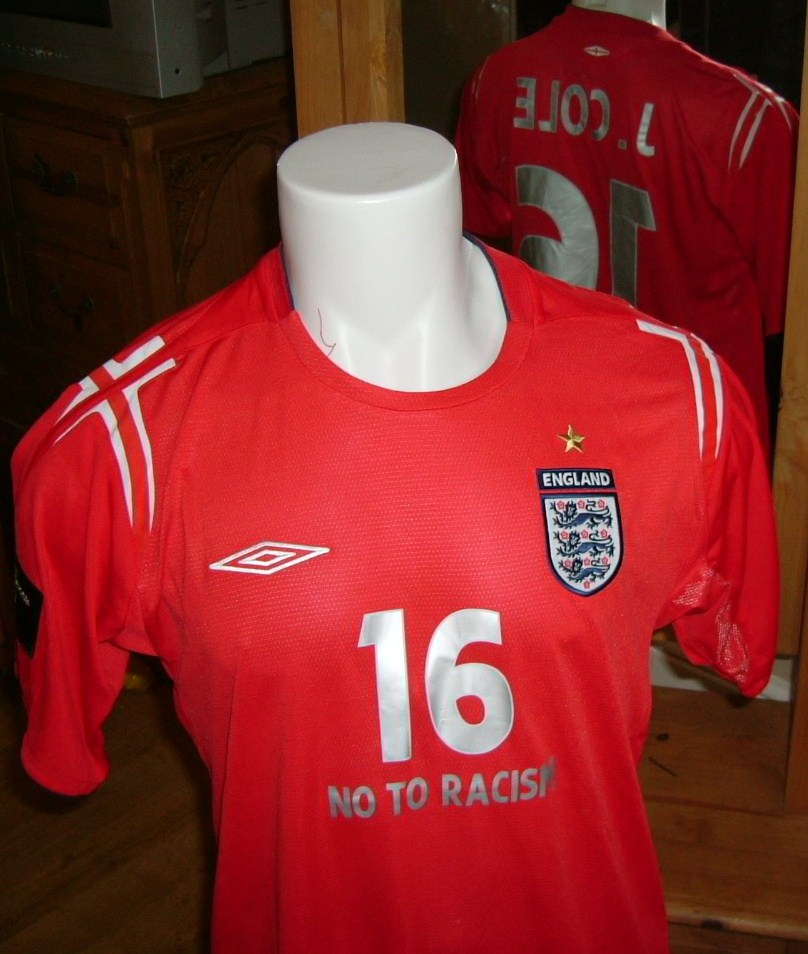
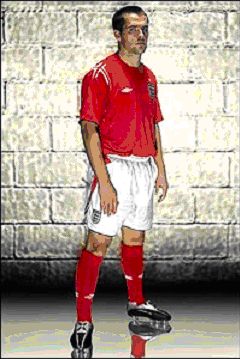
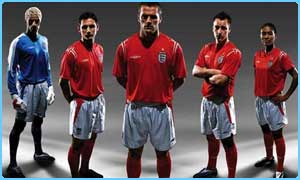
Red crew-neck shirt. Back of
collar edged with navy blue. Thick navy-blue hem at the bottom of the
shirt. Cuffs edged with navy blue, with a thicker outer-half edging.
Large red
cross, bordered by white on each shoulder, each border narrowing at its
end. Small red cross in a white diamond at the back of the neck. Mesh
panel down each side of shirt covering underarm and inner sleeve.
Embroidered emblem on left breast, with 'ENGLAND' in capitalised white
lettering inside a navy-blue panel above the emblem, and a small gold
star above the panel. Two embroidered white concentric diamonds on right
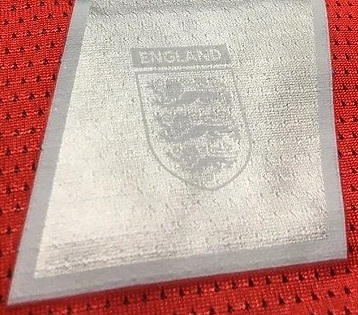
breast. Small, rounded silver rectangular label on back of shirt, attached to right hip,
incorporating a rounded square on the left, containing a holographic
emblem, with 'ENGLAND' in capitalised white lettering inside a navy blue
panel above the emblem, a rounded red rectangle on the right, containing
a white Umbro diamonds logo and a rounded English flag below it, with
2004-2006 above the rectangles, and OFFICIAL PRODUCT below them, both
embossed in capitalised silver characters. Thin silver
plastic
strip running down right hip to the hem, with OFFICIAL ENGLAND TEAM
PRODUCT embossed in capitalised silver lettering running down it.
Silver number on back, bordered in white, and in centre of chest in same font as previous
England shirts. Shadow emblem at base of each number on back, with
'ENGLAND' in capitalised lettering inside a darker panel above
the emblem. Surname in capitalised silver lettering, bordered in white, above number on
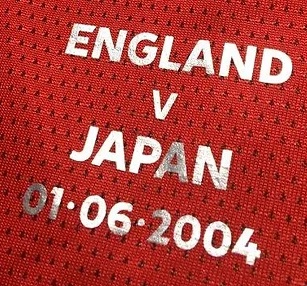
back, in same font as the numbers (the letters Q, X and Z were unused). Match details heat-pressed in silver
underneath number on chest in following format: |
|
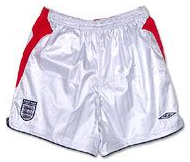
Silver
shorts, with white drawstring. Navy-blue hem. Red waistband around back
of shorts becoming a diagonal stripe curving inwards, before running
down three-quarters of seams diagonally back towards the back and
ending in a point. Small red cross in a white diamond in middle of
waistband on back of shorts. Two embroidered navy-blue concentric
diamonds on left thigh. Navy-blue number, in the same font as on the
shirt, above the Umbro logo on left thigh. Embroidered emblem on right
thigh, with 'ENGLAND' in capitalised white lettering inside a navy-blue
panel above the emblem.
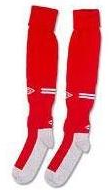
Red
socks. Two large white concentric diamonds on calf. English flag on back
of calf. Small red cross in a white diamond on each heel. White
footings, with red stripe running across top of each foot.
England's captains wore a white armband with the Three
Lions emblem on it, as on the shirts, apart from against Croatia, when
David Beckham wore a white armband featuring a black C. |
|
Variations |
- Against Croatia, England had logos
sewn-on to the upper sleeves. The Euro 2004 tournament logo was on the
right arm and the UEFA Fair Play logo was on the left arm.
- The shirts worn by
Ashley and Joe Cole, and the Neville brothers, also included their first
initial i.e. A. COLE, J. COLE, G. NEVILLE and P. NEVILLE.
- In the game against
Azerbaijan, England had a black-and-white FIFA WORLD CUP GERMANY 2006 logo
embroidered onto
the upper right sleeve, although three players (Butt, Ferdinand and Gary
Neville), all wearing long sleeves, did not wear the logo, whilst two others
in long sleeves (Campbell and Rooney), did.
- The names of
England's opponents, as they appeared in the match details, were AZERBAIJAN,
CROATIA, HOLLAND, ICELAND, JAPAN, POLAND, SWEDEN and UKRAINE. England were named
first in the four home fixtures, and second in the other four fixtures,
which were all played away from home.
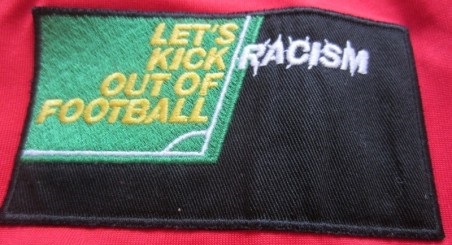
- Against the
Netherlands, the match details were positioned centrally at the bottom of
the shirt, just above the hem. NO TO RACISM was displayed in large silver
capitalised lettering underneath the number on the chest and the LET'S KICK
RACISM OUT OF FOOTBALL logo was sewn on to the upper right sleeve.
|
|
Most Appearances |
7 - Ashley Cole, Steven
Gerrard, Frank Lampard, Gary Neville, Michael Owen
-
34 players appeared in this
kit, in only eight games, coincidentally, the same number of players
that wore each of the two previous kits.
-
Cole was on the field for
the longest time in this shirt, by eight minutes more than Owen, not
counting time added for stoppages at the end of each half.
-
Six players won their first
cap in this shirt. Among them were Jermain Defoe, who went on to win 55
caps, and Shaun Wright-Phillips, who became the first England player to
wear a hyphenated surname on the back of his shirt.
-
Two of them, Anthony Gardner
and Alan Thompson, made their debuts in the same game as Defoe (against
Sweden), but unlike the striker, they were never capped again. Gardner
only played for 45 minutes (the second half).
-
Gareth Southgate was the
only other player to make his last international appearance in the
shirt. It was his 57th.
-
Jonathan Woodgate won eight
England caps over a nine-year period. He played for four different
coaches and wore six different England kit designs. He wore this one on
its debut, against Sweden.
|
|
Top Scorers |
4 - Wayne Rooney
3 - Michael Owen
2 - Frank Lampard,
Darius Vassell
-
Rooney's goals against
Croatia, which helped England to qualify for the European Championship
quarter-finals, took his total for the season to nine. If he had scored
one more, he would have been the first England international to hit
double figures in a season since Gary Lineker in 1991. Rooney did
eventually hit double figures for England in 2008-09.
-
Three players scored their first
international goal in this shirt. Jermain Defoe went on to score 19 for
England.
-
Vassell's brace against
Iceland took his tally to six, on which he remained for the rest of his
international career.
-
Paul Scholes' 14th and last
international goal was the equaliser against Croatia, which set England
on their way to a vital 4-2 win.
|
|
Captains |
6 -
David Beckham
1 -
Steven Gerrard, Michael Owen
-
Beckham only missed two
games, with Gerrard stepping in to captain the side for the first time,
against Sweden, when Beckham and Owen were injured, and Owen taking the
armband in Azerbaijan, when Beckham was suspended.
|
|
|
|
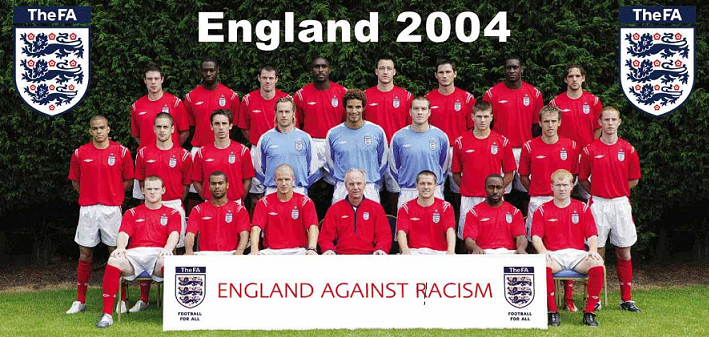
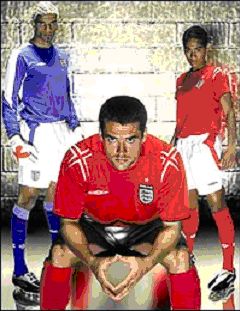
 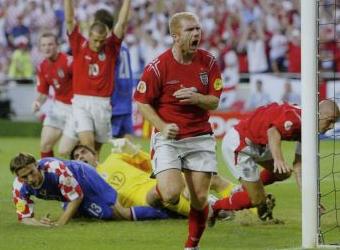 England's extremely attractive 2004 red away strip made its appearance in accord
with the regular cycle, under which home and away strips were changed in
alternate years, so that a new shirt was now appearing every year. England's extremely attractive 2004 red away strip made its appearance in accord
with the regular cycle, under which home and away strips were changed in
alternate years, so that a new shirt was now appearing every year.
The shirt was
the same shade of red
that England wore when winning the World
Cup in 1966 and featured the same rounded
neck. Like the red shirt of the 1960s and early 1970s, it lacked any
trace of blue outside the three-lions emblem.
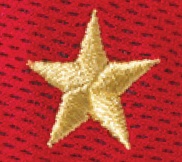 Most notable on the shirt were the
St George's Crosses on the shoulders, which were the only embellishments on
a very clean design. The gold star, which made
its relatively unobtrusive debut on the sleeve of the
2003 home white shirt,
was moved to a
spot above the three-lions emblem, in conformity with the practice
adopted by other national sides that have won the World Cup. Most notable on the shirt were the
St George's Crosses on the shoulders, which were the only embellishments on
a very clean design. The gold star, which made
its relatively unobtrusive debut on the sleeve of the
2003 home white shirt,
was moved to a
spot above the three-lions emblem, in conformity with the practice
adopted by other national sides that have won the World Cup.
A new heat-regulating fabric
called 'X-static' was used for the red shirt and, for the first time, it featured silver player names and numbers, rather than the usual
white. The 'silverwear' theme continued with silvery white shorts, whilst the Umbro logo on the shorts returned to the left thigh, after its brief visit
to the right on the 2003 white and navy shorts.
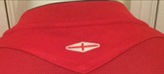 Umbro also got away with a very
clever marketing trick on this kit. Regulations limited the displaying of
manufacturers' logos to one on the shirt, one on the shorts and one on each
sock, but as the Umbro diamond was such an instantly recognisable brand, they
added a red cross inside a small diamond shape on the back of the neck, the back
of the waistband, and on each heel. Unless you were observing them at close
quarters, they appeared to be additional Umbro logos, when in actual fact,
they were English flag embellishments in the same shape as the logo. Thus, Umbro
managed to circumnavigate the restrictions, quite legitimately, with what were,
to all intents and purposes, additional subliminal adverts. Umbro also got away with a very
clever marketing trick on this kit. Regulations limited the displaying of
manufacturers' logos to one on the shirt, one on the shorts and one on each
sock, but as the Umbro diamond was such an instantly recognisable brand, they
added a red cross inside a small diamond shape on the back of the neck, the back
of the waistband, and on each heel. Unless you were observing them at close
quarters, they appeared to be additional Umbro logos, when in actual fact,
they were English flag embellishments in the same shape as the logo. Thus, Umbro
managed to circumnavigate the restrictions, quite legitimately, with what were,
to all intents and purposes, additional subliminal adverts.
The kit was launched in the spring
of 2004, in plenty of time for the European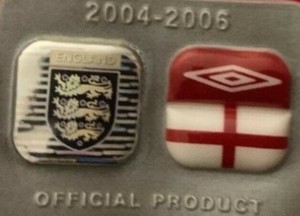 Championship in Portugal and it
received maximum exposure in all of England's internationals before the
tournament, including the two games at the City of Manchester Stadium, as part
of the Football Association's Summer Tournament (though officially still late
spring). It appeared for a stirring victory against Croatia, as England booked
their place in the quarter-finals of Euro 2004 and for four games in the
following season. The final appearance, a friendly against the Dutch, coincided
with UEFA's anti-racism campaign and saw England wearing a slogan on their
shirts for the first time in their history. Their opponents, for their part,
wore a symbolic shirt of black-and-white halves. Championship in Portugal and it
received maximum exposure in all of England's internationals before the
tournament, including the two games at the City of Manchester Stadium, as part
of the Football Association's Summer Tournament (though officially still late
spring). It appeared for a stirring victory against Croatia, as England booked
their place in the quarter-finals of Euro 2004 and for four games in the
following season. The final appearance, a friendly against the Dutch, coincided
with UEFA's anti-racism campaign and saw England wearing a slogan on their
shirts for the first time in their history. Their opponents, for their part,
wore a symbolic shirt of black-and-white halves. |
|
Matches in which England wore the
2004 Away Red Uniform |
|
Season 2003-04 |
|
|
Sven-Göran Eriksson |
|
Friendly match |
|
811 |
31 March 2004 -
Sweden
1 England 0
[0-0]
Nya Ullevi Stadion, Heden,
Göteborg (40,484) |
Ibrahimović |
AL |
|
FA Summer Tournament |
|
|
812 |
1 June 2004 - England 1
Japan 1
[1-0]
City of Manchester Stadium,
Eastlands, Manchester (38,581) |
Owen
Ono |
HD |
|
813 |
5 June 2004 - England 6
Iceland 1
[3-1]
City of Manchester Stadium,
Eastlands, Manchester (43,500) |
Lampard, Rooney
(2), Vassell (2),
Bridge
Helguson |
HW |
|
European Championship Finals in Portugal |
|
|
816 |
21 June 2004 -
Croatia 2
England 4
[1-2]
Estádio do Sport Lisboa e
Benfica, Bairro Dona Leonor, Lisboa (57,047) |
N Kovač, Tudor
Scholes,
Rooney (2),
Lampard |
NW |
|
Season 2004-05 |
|
Friendly match |
|
|
818 |
18 August 2004 - England 3
Ukraine 0
[1-0]
St James' Park, Gallowgate,
Newcastle upon Tyne (35,387) |
Beckham,
Owen, Wright-Phillips |
HW |
|
World Cup Preliminaries |
|
|
820 |
8 September 2004 -
Poland
1 England 2
[0-1]
Stadion Śląski, Katowicka,
Chorzów (38,000) |
Żurawski
Defoe,
Głowacki OG |
AW |
|
822 |
13 October 2004 -
Azerbaijan 0
England 1
[0-1]
Tofiq Bəhramov adına Respublika
Stadionu, Narimanov, Baku (15,000) |
Owen |
AW |
|
Friendly match |
|
|
824 |
9 February 2005 - England 0
Netherlands 0
[0-0]
Villa Park, Aston, Birmingham
(40,705) |
|
HD |
It was also worn on the bench by
unused substitutes,
Danny Mills and Jlloyd Samuel against Sweden, and by Matthew Upson
against Ukraine.
1/2/3/4/5
indicates the players that wore the long-sleeved version and the
number of matches in which they wore it (Bridge,
Carragher, Ferdinand, Heskey, King, Thompson and Wright-Phillips only wore
the long-sleeved version of this shirt). Each
of the Neville brothers broke the habit of their international career by
wearing a different length of shirt sleeve to that which they'd worn in
every other full international. Phil wore short sleeves for the first time,
against Croatia in Portugal, whilst Gary's switch was to long sleeves in
Azerbaijan.
|
Matches in which England Under-21 wore the
2004 Away Red Uniform |
|
Season 2004-05 |
|
|
Peter
Taylor |
|
Friendly |
|
220 |
17 August 2004 -
England 3 Ukraine 1 [2-0]
Riverside
Stadium, Middlesbrough (5,658) |
Cole
(2),
Bent
Aliyev |
HW |
|
England: Scott
Carson, N.Hunt (J.Hoyte), M.Richards (D.Harding), A.Ferdinand, M.Kilgallon,
James Milner (Darren Bent), J.Pennant, G.O'Neilᶜ, Carlton Cole (Dean Ashton),
J.Stead (P.Whittingham), Stewart Downing (N.Reo-Coker). |
|
UEFA Under-21 Championship 2006
preliminaries (group 6) |
|
|
222 |
7 September 2004 -
Poland 1 England
3 [1-1]
Stadion
Miejskiego Ośrodka Sportu i Rekreacji, Rybnik
(3,000) |
Burkhardt
Cole, Bent
(2 (1 pen)) |
AW |
|
England: Scott
Carson, Glen Johnson, Leighton Baines (J.Hoyte), A.Ferdinand (M.Kilgallon),
C.Davenport, N.Reo-Coker, J.Pennant, G.O'Neilᶜ, Carlton Cole, David Bentley
(Darren Bent), James Milner. |
|
224 |
12 October 2004 -
Azerbaijan 0 England 0 [0-0]
Shafu Stadium, Baku
(1,500) |
|
AD |
|
England: Scott
Carson, N.Hunt, D.Harding, Glen Johnson, C.Davenport (M.Kilgallon), G.O'Neilᶜ
(Stewart Downing), J.Pennant, James Milner, J. Stead, N.Reo-Coker,
P.Whittingham. |
|
Friendly |
|
|
226 |
8 February 2005 -
England 1 Netherlands 2 [1-2]
Pride Park Stadium, Derby
(33,184) |
Lita
John, Rojer |
HL |
|
England: Scott
Carson (L.Camp), J.Hoyte (L.Lita), Leighton Baines (J.Welsh), Tom
Huddlestone, S.Taylor, L.Ridgewell, W.Routledge (D.Marney), P.Whittingham,
Carlton Coleᶜ (J.Stead), Dean Ashton (Kieran Richardson), James Milner. |
|
UEFA Under-21 Championship 2006
preliminaries (group 6) |
|
|
227 |
25 March 2005 -
England 2 Germany 2 [0-0]
Kingston Communications Stadium, Hull
(21,746) |
Bent, Ashton
Kieβling, Hilbert |
HD |
|
England: Scott
Carson, Glen Johnson, L.Ridgewell (J.Welsh), N.Hunt, C.Davenport, Tom
Huddlestone, James Milner, G.O'Neilᶜ (S.Taylor), Darren Bent, Dean Ashton,
Kieran Richardson, (L.Rosenior). |
|
Season 2005-06 |
|
231 |
6 September 2005 -
Germany 1 England 1 [1-1]
Bruchwegstadion,
Mainz
(7,000) |
Kieβling
Taylor |
AD |
|
England: Scott
Carson, S.Taylor, N.Hunt (Leighton Baines), Michael Dawson, A.Ferdinand,
N.Reo-Cokerᶜ, James Milner, G.O'Neil, Carlton Cole, J.Welsh (David Nugent),
P.Whittingham (T.Soares). |
The Under-21s' shirt had the
same match details format on the chest, with the team names appearing as AZERBAIJAN U21, ENGLAND U21, GERMANY U21, HOLLAND
U21, POLAND U21 and UKRAINE U21. England were named
first in the three home fixtures and second in the three away games. Surnames
were also worn on the back of the shirts.
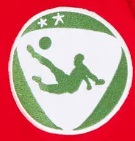
In the UEFA Under-19 Championship finals in
Northern Ireland in 2005, England wore the tournament logo on the right
sleeve:
All of England's other teams (including the women's) also wore the same
design, but did not have their names on the back or display match details.
|
England's Record
wearing the 2004 Away
Shirt |
|
Type |
P |
W |
D |
L |
F |
A |
GD |
FTS |
CS |
FAv |
AAv |
Pts % |
W/L |
|
Home |
4 |
2 |
2 |
0 |
10 |
2 |
+8 |
1 |
2 |
2.500 |
0.500 |
75.0 |
+2 |
|
Away |
3 |
2 |
0 |
1 |
3 |
2 |
+1 |
1 |
1 |
1.000 |
0.667 |
66.7 |
+1 |
|
Neutral |
1 |
1 |
0 |
0 |
4 |
2 |
+2 |
0 |
0 |
4.000 |
2.000 |
100.0 |
+1 |
|
Total |
8 |
5 |
2 |
1 |
17 |
6 |
+11 |
2 |
3 |
2.125 |
0.750 |
75.0 |
+4 |
|
England's Under-21 Record
wearing the 2004
Away
Shirt |
|
Type |
P |
W |
D |
L |
F |
A |
GD |
FTS |
CS |
FAv |
AAv |
Pts % |
W/L |
|
Home |
3 |
1 |
1 |
1 |
6 |
5 |
+1 |
0 |
0 |
2.00 |
1.667 |
50.0 |
=0 |
|
Away |
3 |
1 |
2 |
0 |
4 |
2 |
+2 |
1 |
1 |
1.333 |
0.667 |
75.0 |
+1 |
|
Total |
6 |
2 |
3 |
1 |
10 |
7 |
+3 |
1 |
1 |
1.667 |
1.167 |
58.3 |
+1 |
____________________
JB/PY/CG
|
|
 England
Football Online
England
Football Online



 to
to