|
|
|
Match
Summary |
|
|
  Officials Officials |
England |
Type |
West Germany |
Referee
(black) - Gottfried
Dienst
46 (9 September 1919), Basel,
Switzerland
Linesmen -
Orange -
Tofik Bakhramov, 39 (29 November 1926), Soviet Union & Flame -
Dr. Karol Galba, 45 (2 February 1921), Czechoslovakia.
This was the 200th-ever World Cup finals
match. Any replay would be played on Tuesday, 2nd August;
Trophy presented by HM Queen
Elizabeth II.
|
|
Goal Attempts |
|
|
|
Attempts on Target |
|
|
|
Hit Bar/Post |
|
|
|
Corner Kicks Won |
|
|
|
Offside Calls Against |
|
|
|
Fouls Conceded |
|
|
|
Possession |
|
|
|
flg.jpg) England
Team England
Team |
| |
|
Rank: |
No official ranking system established;
ELO rating 2nd to 1st |
Colours: |
The 1966 Umbro
away uniform
- Red crew-necked jerseys, white shorts, red socks. |
|
England wore red because they lost the toss of coin. |
|
Capt: |
Bobby Moore, thirtieth captaincy |
Manager: |
Alfred
Ernest Ramsey, 46 (22 January 1920), appointed
25 October 1962, effective part-time 31 December, full from May 1963.
44th match, W 29 - D 9 - L 6 - F 106 - A 52. |
|
England
Lineup |
|
1 |
Banks, Gordon |
28 |
30 December 1937 |
G |
Leicester City FC |
33 |
32ᵍᵃ |
|
2 |
Cohen, George
R. |
26 |
22 October 1939 |
RB |
Fulham FC |
30 |
0 |
|
3 |
Wilson, Ramon |
31 |
17 December 1934 |
LB |
Everton FC |
51 |
0 |
|
4 |
Stiles, Norbert P. |
24 |
18 May 1942 |
RM |
Manchester United FC |
20 |
1 |
|
5 |
Charlton, John |
31 |
8 May 1935 |
CB |
Leeds United AFC |
22 |
2 |
|
6 |
Moore, Robert F.C. |
25 |
12 April 1941 |
CB |
West Ham United FC |
47 |
2 |
|
7 |
Ball, Alan
J. |
21 |
12 May 1945 |
RF |
Blackpool FC |
14 |
1 |
16
  |
Peters,
Martin S. |
22 |
8 November 1943 |
LM |
West Ham United FC |
8 |
2 |
|
Peters was cautioned in the first half for unsporting behaviour,
for tussling with Wolfgang Overath just outside the centre-circle. |
|
9 |
Charlton, Robert |
28 |
11 October 1937 |
CM |
Manchester United FC |
74 |
40 |
10
|
Hurst,
Geoffrey C. |
24 |
8 December 1941 |
CF |
West Ham United FC |
8 |
5 |
|
the 66th
(29th post-war)
hattrick scored |
|
21 |
Hunt, Roger |
28 |
20 July 1938 |
LF |
Liverpool FC |
19 |
15 |
|
reserves: |
8-Jimmy Greaves, 11-John Connelly, 12-Ron Springett,
13-Peter Bonetti, 14-Jimmy Armfield, 15-Gerry Byrne, 17-Ron Flowers,
19-Terry Paine, 20-Ian Callaghan, 22-George Eastham. |
|
team notes: |
Gordon Banks equals
Ron Springett's record of being the most capped goalkeeper. |
|
records: |
The hat-trick, the 67th scored by England
since the first in 1882, is the ninth at Wembley, and the first for
England in a finals tournament. |
|
|
|
4-3-3 |
Banks -
Cohen, J. Charlton, Moore, Wilson -
Stiles, R. Charlton, Peters -
Ball, Hurst, Hunt |
|
Averages: |
Age |
26.2 |
Appearances/Goals |
29.6 |
5.8 |
|
England World Cup teams v. Uruguay (first match) & West Germany (final): |
|
first: |
Banks |
Cohen |
Wilson |
Stiles |
J.Charlton |
Moore |
Ball |
Greaves |
R.Charlton |
Hunt |
Connelly |
|
final: |
Banks |
Cohen |
Wilson |
Stiles |
J.Charlton |
Moore |
Ball |
Hunt |
R.Charlton |
Hurst |
Peters |
|
|
|
|
 West
Germany
Team West
Germany
Team |
| |
|
Rank: |
No official ranking system established;
ELO rating 1st
to 2nd |
Colours: |
Made by Umbro - White jerseys with round black collar and cuffs,
black shorts, white socks. |
|
Capt: |
Uwe Seeler |
Manager: |
Helmut Schön, 50 (15 September 1915), appointed 1964; |
|
West
Germany
Lineup |
|
1 |
Tilkowski, Hans |
31 |
12 July 1935 |
G |
BV Borussia 1909 eV
Dortmund |
38 |
0 |
|
2 |
Höttges,
Horst-Dieter |
22 |
10 September 1943 |
RB |
SV Werder Bremen |
18 |
1 |
|
3 |
Schnellinger, Karl-Heinz |
27 |
31 March 1939 |
LB |
AC Milan, Italy |
36 |
0 |
|
4 |
Beckenbauer, Franz |
20 |
11 September 1945 |
M |
FC Bayern München eV |
14 |
7 |
|
5 |
Schulz, Willi |
27 |
4 October 1938 |
CD |
SV Hamburger eV |
37 |
0 |
|
6 |
Weber,
Wolfgang |
22 |
26 June 1944 |
CD |
1.FC Köln |
18 |
1 |
|
12 |
Overath, Wolfgang |
22 |
29 September 1943 |
M |
1.FC Köln |
22 |
6 |
|
8 |
Haller,
Helmut |
27 |
21 July 1939 |
M |
Bologna FC 1909 SpA, Italy |
27 |
5 |
|
9 |
Seeler,
Uwe |
29 |
5 November 1936 |
RF |
SV Hamburger eV |
54 |
36 |
|
10 |
Held, Siegfried |
23 |
7 August 1942 |
CF |
BV Borussia 1909 eV
Dortmund |
10 |
1 |
|
11 |
Emmerich, Lothar |
24 |
29 November 1941 |
LF |
BV Borussia 1909 eV
Dortmund |
5 |
2 |
|
unused substitutes: |
7-Albert Bruells, 13-Heinz Hornig, 14-Freidel Lutz,
15-Bernd Patzke, 16-Max Lorenz, 17-Wolfgang Paul, 18-Klaus-Dieter Sieloff,
19-Werner Kraemer, 20-Jürgen Grabowski, 21-Günter Bernard, 22-Joséf Maier. |
|
|
|
4-3-3 |
Tilkowski -
Höttges,
Schulz, Weber, Schnellinger -
Beckenbauer, Haller, Overath -
Seeler, Held, Emmerich |
|
Averages: |
Age |
24.9 |
Appearances/Goals |
25.4 |
5.1 |
|
|
|
|
Match Report
by Mike Payne |
|
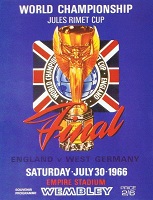 The
World Cup had come home at last! England, the pioneers of organised
football were the new World Champions after an afternoon of high excitement,
emotion, tension and drama that Wembley Stadium had never seen the like of
before. The
World Cup had come home at last! England, the pioneers of organised
football were the new World Champions after an afternoon of high excitement,
emotion, tension and drama that Wembley Stadium had never seen the like of
before.
From early in the
morning, the atmosphere was electric. The crowd flocked to Wembley from
all corners of the world and at kick-off time on a day of squally showers and
bright sunshine, the stadium was a sea of waving flags. As the teams
marched into the arena, the emotion of the occasion made even the most hardened
spectator clear the lump from his throat. It was a magical moment in the
history of English football.
The noise was deafening and from high
in the stand there came a beating of a drum, a deep pulsating throb that lasted
throughout the game. Her Majesty The Queen and The Duke of Edinburgh were
introduced to the teams and after all the preliminaries were over, Gottfried
Dienst, the referee from Switzerland, blew the opening whistle.
Both sides tentatively felt each other
out in the early stages and they found the pitch treacherous after two heavy
showers had fallen just before the start. It was ripe for error.
That statement proved fatally correct in the 13th minute when Ray Wilson
misjudged a headed clearance from Seeler's deep cross. The ball dropped
straight at Haller's feet and the German forward wasted no time in hitting a
shot into the far corner of Gordon Bank's goal. One could feel the wave of
disappointment that swept from the terraces, at least from the English
contingent. But thankfully, the home supporters did not have to wait long
for a reply.
Only six minutes after the goal,
England equalised. Overath unfairly tackled Bobby Moore and the captain
quickly spotted a gap in the German rearguard. His instant free-kick
floated beautifully 35 yards to the middle and there was Geoff Hurst leaping
unchallenged to direct a downwards header to the right of the flat-footed
Tilkowski. It was a vital goal.
So, all-square and plenty to play for.
Near-misses came at both ends. Banks made two saves in as many seconds
from Overath and Emmerich, whilst at the other end Tilkowski parried a left-foot
rocket from Roger Hunt after a good pass by Martin Peters. The goalkeeper
then needed treatment after a 20-yard fizzer by Bobby Charlton beat his dive but
struck the post and bounced back into Tilkowski's face before being cleared.
The half ended at one goal each and
both sets of players walked off to get fresh inspiration from their respective
managers. When the teams reappeared, more slanting rain fell, glinting
through the watery sunshine. The half opened with some cagey play from
both sides. Each sought a chink in the armour of the other's defence and
the game went into a relatively quiet spell. The referee annoyed the crowd
with some irritating decisions and goal chances were few and far between.
A deep cross by Peters out on the left
was met by Bobby Charlton and another fierce shot went only just wide. As
the game wore on, both teams tensed up not daring to make the mistake that might
settle the issue. But with 13 minutes to go, the stadium erupted.
Alan Ball, who showed boundless energy
throughout and covered every blade of the Wembley turf, now forced a corner on
the right. He took the kick himself and the ball eventually reached Hurst.
Hurst aimed a rather speculative shot goalwards but Höttges deflected it into
the path of Peters and Jack Charlton.
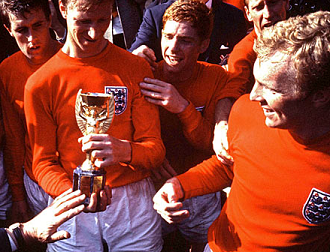 Peters was there first and his
bundled shot billowed the West German net to roars of delight from the crowd. Peters was there first and his
bundled shot billowed the West German net to roars of delight from the crowd.
We
thought that was it, but these Germans were not beaten until the very last
whistle sounded. Reinforced by Schnellinger and with the tireless efforts
of Haller, Overath, Held and Beckenbauer, they kept pushing forward. Moore
and Nobby Stiles were masterly in defence, but with the last minute unwinding,
and with Moore's hands all but on the trophy, the Germans found a sensational
equaliser.
A somewhat harsh decision gave the
Germans a free-kick against Jack Charlton. With everyone back behind the
ball, Emmerich blasted the kick against the English wall. The ball rebounded to
Held, who blazed wildly sending it across goal. There was a suspicion of
handball against Schnellinger but eventually it ran wide and in came Weber to
stun the whole of England by crashing the ball past Banks's despairing dive.
England just had time to kick-off again
before the referee blew his whistle for the end of 90 minutes. Alf Ramsey
came on, as did most of the England World Cup party, and his first task was to
get the players on their feet ready for the extra-time period. Many sides
would have folded after having had victory snatched from their grasp in such
dramatic fashion, but not England. They rolled up their sleeves and rolled
down their socks and prepared for battle all over again.
The energy-sapping pitch was having
dire consequences and many players were suffering from cramp. England
stuck to the pattern which had served them so well. Stiles and Moore
mopped up the Germans' central thrusts, Bobby Charlton and Peters provided from
midfield, Ball scurried here, there and everywhere and up front Hurst and Hunt
battered away at the German defences.
Extra-time approached its half-way
stage as Stiles sent Ball on another lung-bursting run to a through-ball.
The fiery red-haired number-seven collected and put in an instant centre.
Hurst trapped the ball with his back to goal, swivelled, and crashed a
tremendous shot which thudded against the bar, bounced down and was then headed
clear by Weber.
"Goal," shouted Hunt, who turned
immediately to salute Hurst's shot. The Germans disagreed, convinced the
ball had not crossed the line. The England fans bayed as the referee
trotted over to the Soviet linesman, Tofik Bakhramov. There was an
agonising wait as the two engaged in a tense conversation. But at the end
of it all, Mr Dienst pointed to the middle and the English celebrations began in
earnest. The Germans argued but the record book had been written and at
half-time in extra-time, the score was 3-2 to England.
How the two sides managed to see out
the last stage of this two-hour epic was beyond praise and marvellous testament
to the wonderful level of fitness, the two squads had reached. The minutes
ticked away, England feared another German comeback, but then, finally, with
seconds left, the greatest day in the history of English football was sealed by
a fourth goal.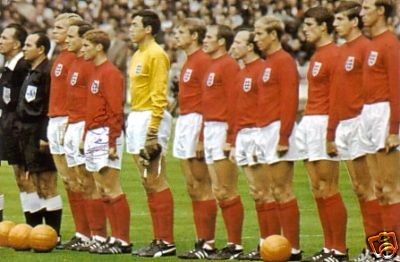
Moore, in majestic form even at this
late stage, put another superb defence-splitting pass through the wide open
spaces of the German defence, exposed by their desperate attacking commitment. On to it ran Hurst and the West Ham combination reached a remarkable climax at a
rasping shot from Hurst's left foot flew into the top corner of Tilkowski's net.
A hat-trick for Hurst and the first time that a player had achieved that feat in
a World Cup Final.
Seconds later, the whistle blew to end
a passionate afternoon. Ball leapt on Hurst, Jack Charlton sank to the
floor in sheer fatigue and unashamed joy, whilst brother Bobby's face just
crumpled into a flood of tears. The scenes were marvellously
unforgettable.
The walk up the steps for the team to
receive the trophy was a proud moment and when Moore lifted the World Cup to the
heavens, the roar could be heard for miles around. And who will ever forget
Nobby Stiles, doing his victory jig on the lap of honour, his toothless smile an
image that would be on the front pages of every newspaper the following day.
England were World Champions and worthy
winners.
|
|
Match Report
by Norman Giller |
|
Alf Ramsey
decided to stick with an unchanged team. No place for fit-again Jimmy
Greaves. West Germany took the negative approach of putting Franz
Beckenbauer on man-to-man marking duty against Bobby Charlton, so the two
most creative players on the pitch cancelled each other out. This
was manager Helmut Schön's reaction to Charlton's spectacular show
against Portugal. A rare Ray Wilson mistake on a wet surface let Helmut
Haller in for a thirteenth-minute goal which was equalised six minutes
later when Hurst headed in a perfectly-flighted free-kick from his West
Ham team-mate Bobby Moore. Just after the hour a Hurst shot was blocked
and it was another West Ham-mer, Peters, who smacked the rebound smartly
into the net to make it 2-1. England were one minute from the World Cup
when Jack Charlton was adjudged to have fouled Germany's skipper Uwe
Seeler. During a goalmouth scramble that followed the free-kick defender
Wolfgang Weber forced the ball into the net, with skipper Bobby Moore
insisting there had been a handball. Ten minutes into extra-time, the
inexhaustible Alan Ball made one of his many scampering runs past
left-back Schnellinger and centered the ball. Hurst turned and fired a
first-time shot against the underside of the bar, and England claimed
the ball had crossed the goal-line. Swiss referee Gottfried Dienst awarded a
controversial goal after consulting the
Soviet linesman Bakhramov. To
this day, the Germans dispute the decision. Hurst ended all arguments in
the final seconds when he ran on to a clearance from Bobby Moore and
hammered a left-foot shot past goalkeeper Hans Tilkowski to complete the
first-ever World Cup hat-trick. England, just as Alf Ramsey had
prophesied, were champions of the world.
|
|
Match Report
by Glen Isherwood |
|
England had never previously been
beyond the quarter-finals and no host nation had won the World Cup since
Italy in 1934. West Germany had won the trophy in 1954, surprisingly
beating Hungary 3-2 in the final in Bern. They had never beaten England,
though, and had lost at Wembley just five months earlier. England were
wearing red shirts for only the third time at Wembley, and the first since
1954 when they beat West Germany.
West Germany went in front when Held's cross
was inexplicably headed down by Wilson into the path of Helmut Haller who
stroked it past Banks into the corner. England were level within just six
minutes. A quick free-kick from Moore found the head of Geoff Hurst who
directed it into the net.
England did not take the lead until late in the game when from Ball's
corner Hurst's shot was deflected by Höttges to leave Martin Peters,
in the six-yard box, with a simple chance. England held out until the
very-last minute when West Germany snatched a desperate equaliser.
Emmerich's free-kick was blocked by Cohen. It fell to Held who shot. The
ball hit Schnellinger's back and ran on to Wolfgang Weber despite
England's protests of handball. Weber slid in to beat Wilson, and Banks,
who was scrambling across after diving for Held's shot.
England regained the lead in extra-time with, arguably, the most
controversial goal ever scored. Ball crossed, Hurst controlled it and then
shot on the turn. The ball struck the underside of the bar and bounced
down and out. The referee, unsure as to whether it had gone in or not,
consulted his assistant, who had not been up with the play. The linesman
pointed to the centre-circle and the goal was given. None of the numerous
camera angles could prove conclusively whether the ball had crossed the
line or not and the debate raged for decades. In the dying seconds, with
spectators already encroaching onto the pitch, Moore sent Hurst away to
beat Tilkowski and become the first man to score a hat-trick in a World
Cup final. A historic and dramatic occasion had finally ended in a
deserved victory for England.
England's win earned manager Alf Ramsey a kinghthood. The controversial
third goal should not detract from a magnificent team effort in Wembley's
greatest-ever football spectacle. Sadly, England have failed to emulate
the men of 1966 whereas West Germany won the World Cup twice since then.
England's defence of the trophy in 1970 in Mexico ended in the
quarter-finals when they were beaten after extra-time by West Germany
despite taking a two-goal lead. The Germans lost in the semi-finals but by
the time they returned to Wembley in 1972 they were on their way to a
European Championship and World Cup 'double'.
|
|
Match Report
as appears in the F.A. Yearbook 1967-68 pages 43-44 |
|
Relying upon the same team which had seen them through the
previous two rounds, England won a notable game by 4-2 after extra-time.
The match was played amid intermittent showers and sunshine, thunder and
lightning. In the opening minutes, Germany looked the more dangerous with
Haller and Held leading menacing sorties on the rock-like England defence.
Seeler, too, using his head to great advantage, was in virile form and it
came as no surprise when the Germans took the lead after 12 minutes, when
Haller took advantage of a misdirected header by Wilson, moved forward and
shot from some 12 yards into the far corner of the net with Banks
helpless. At the time, the reverse looked bleak for England as it was the
first time in the Competition that they were behind and the first goal to
be scored against England other than Eusébio's penalty. Moore,
Stiles, Peters and Bobby Charlton, however, had other ideas in midfield
and from that point onwards, England got to grips with the game and
gradually subdued their lively opponents. The equalizing goal was scored
by Hurst six minutes later. He neatly positioned himself to head home a
quickly-taken free-kick by Moore.
Germany continued to be menacing for the remainder of the first half but
the second period told a different tale with England always looking for
the goalscoring opportunity. In spite of pressure, however, and a
none-too-safe goalkeeper in Tilkowski, the German defence gave little way
and only 12 minutes remained when Peters scored following a centre from
Hurst which struck a German defender and landed at Peters' feet. Just as
England were waiting for the final whistle, Jack Charlton was adjudged,
harshly, to have fouled on the edge of the area. The free-kick appeared to
strike a German hand before rolling on to Weber who shot past Banks.
Tension was at fever pitch as the teams began extra-time. England,
however, looking the fitter and fresher, maintained their confidence and
composure and Hurst scored with a brilliant drive which hit the underside
of the crossbar to fall over the line with Tilkowski completely beaten.
German protests were rejected after the referee had spoken to the
linesman. With the last kick of the game, Hurst completed a personal
triumph by scoring with a splendid shot from some 25 yards.
England had thus won the World Cup for the first time in five attempts.
|
In
Other News....
|
It was on 30 July 1966
that the Jules Rimet trophy that England had just won was
swapped by a policeman in England's dressing room with a
replica that the Football Association had secretly paid for,
against FIFA rules. The original had been stolen, four
months earlier, but then recovered, and it was the replica
that was used in all future publicity shots over the next
four years. In 1983, the original was stolen again, in Rio
de Janeiro, and has not been seen since. |
|
|
 Source Notes Source Notes |
TheFA.com
Deutscher Fuβball-Bund
FIFA.com
Original newspaper reports
Official matchday programme - courtesy of Geoff Mills.
Rothman's Yearbooks
Mike Payne's England: The Complete Post-War Record
(Breedon Books Publishing Company, Derby, U.K., 1993)
Norman Giller, Football Author
Cris Freddi's Complete Book of the
World Cup
____________________
CG
|
 England
Football Online
England
Football Online
 409
409.jpg)