|
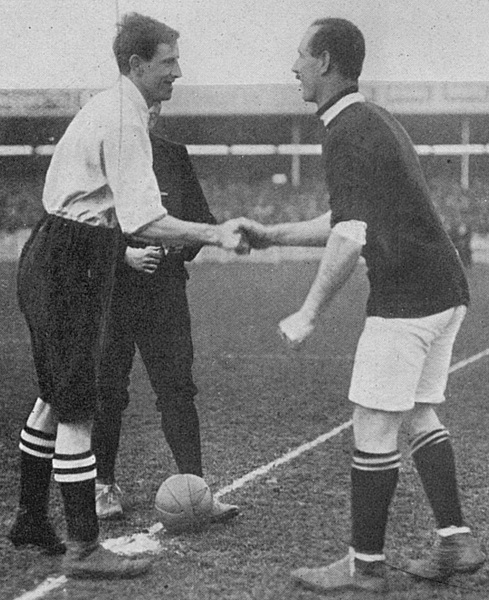
V. J. Woodward, who
captained the home side, won the toss, and decided to play with the sun
behind his back, and with an oblique wind in his favour. The initial dash
by the Welsh forwards was pulled up by Wedlock, who made considerable
ground and then pushed the ball through to Holley, who had Roose well
beaten with a rasping shot that travelled right across the goal and just
missed the farther post. This was a very narrow escape, and within a
minute there was another, as Woodward indulged in some juggling, and
having drawn the defence, sent Freeman off, the latter only losing the
ball through a partial stumble when within a half-dozen yards of goal. The
English halves were playing a fine spoiling game, and they were keeping
their forwards so well fed that the latter were able frequently to
threaten danger. The Welsh defence, however, was safe, Morris being
particularly prominent, and it was subsequent to one of his clearances
that Meredith dashed away on the right and dropped the ball nicely in
front of goal. Davies, the centre, had a race with Crompton for
possession, and the latter, getting his head to the ball, sent on to
Wedlock, who started Bridgett in a run which Blew summarily closed. Two
fouls against Wales were given, Parry coming under the ban of the referee
for indulging in questionable tactics. Pentland here left the field, and
during his absence Warren pulled up Lot Jones and then pushed the ball
through to Woodward. Clever work between the latter and Freeman ended in
the Evertonian making an opening for Holley, and he shot past Roose from
ten yards' range, England taking the lead sixteen minutes from the start.
Pentland returned shortly afterwards, but although he did not lack the
will, he could not get going in his usual style, and this meant that
Woodward had additional work thrown upon him. Danger, however, frequently
threatened Wales, and there were some thrilling tussles between Freeman
and Woodward on the one side and Morris and Peake on the other.
As the game got older, so did the
visitors improve. Meredith had not had much to do, but his confreres now
began to sedulously feed him, and as Veitch allowed him plenty of liberty,
the Mancunian got in a succession of centres and shots that sorely
troubled the home defence. On several occasions, when Veitch was well down
the field, Pennington rushed across, and as between the West Bromwich man
and Meredith honours were about even. Although some good work was also
done on the Welsh left, and the inside men were well plied with the ball,
they were kept so well in hand that they seldom troubled Hardy. The
English forwards were much more insistent, and although their shooting
lacked accuracy, it did not lack force, Holley, Bridgett, and Freeman all
missing the posts by a few feet. One terrific shot by Freeman was going
straight for the corner of the goal, with Roose at the other end, but
Morris headed out from almost under the bar, and in a few seconds the
goalkeeper cleared an express drive from Holley, and threw away a neat
header from Woodward. Bridgett was left, after a short bombardment of the
Welsh goal, with a ridiculously easy chance of scoring, but he lofted the
ball over the bar. From the kick off Meredith was given a clear run, and
having only Pennington to beat, he worked in and brought Hardy to his
knees with a lovely shot. For some minutes Wales more than held her own,
but she could not make any definite impression on the solid defence
opposed to her. The English left wing changed the venue of play, and next
came a bout of passing, in which Warren, Woodward, and Pentland figured,
the movement being ended by Holley heading into Roose's hands. Nearing the
interval England applied severe pressure, and consummate strategy by
Woodward enabled him to give Freeman a clear opening, and the centre
forward promptly netted with a shot that Roose had no chance to save.
The first half ran strongly
in favour of the home country, but Wales certainly had the better of the
exchanges in the second half. There appeared to be contentment among the
English players at what they had achieved, and they developed a lethargy
that boded ill for their success. On the other hand, the Welshmen were
much quicker on the ball, and yet they were seldom dangerous in front of
goal. The only player who seemed likely to score was Meredith, and early
on he made a long, sinuous run, during which he outwitted Veitch and
rounded Pennington, but he had still to reckon with Hardy, and the
goalkeeper was equal to a powerful cross drive, which must have scored
against a less daring keeper. Before relief came to a harassed English
defender, Davies (centre) was presented with an opening, but he shot high
over the bar.
The Rose next had a turn at attacking,
Wedlock starting a movement in which all the forwards took part, and
Pentland, outwitting Morris, lifted the ball to Holley, who headed over.
Roose several times ran out and cleared, and Morris, when hard pressed,
had no hesitation in sending back to the goalkeeper, but this almost
brought about disaster, as Freeman was on one occasion within half a yard
of the ball when Roose made a dive, and managed to get it away. Back to
the other end raced the Welsh forwards, and Crompton twice kicked away
from close quarters, while Hardy had to deal with a shot by Jones. By way
of relief, Bridgett indulged in a solo run, the finest individual effort
of the match. Receiving the ball well in his own half, he tricked man
after man, and concluded with a powerful drive that missed the goal by a
couple of yards. Shortly afterwards Parry left the field, but the visitors
fully held their own in a somewhat tame finish.
|
 England
Football Online
England
Football Online




flg.jpg)

.jpg)
 ¹²
¹²