 England
Football Online England
Football Online |
|
Players
Index |
Page Last Updated
29 July 2022 |

|
|
| |
|
'Now let's make those bastards up there eat every word they've
printed' |
|
|
|
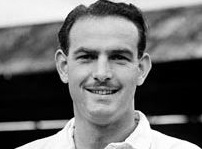
George
Hardwick |
Middlesbrough FC
,%20George.jpg) 13 appearances, 0 goals,
one penalty missed 13 appearances, 0 goals,
one penalty missed
P 13 W 10 D 2 L 1 F
49:
A 12
85% successful
1946-48
captain: 13
minutes played: 1170 |
|
 |
|
Timeline |
| |
George Francis Moutrey Hardwick |
|
name
notes |
Moutrey was his mothers maiden name. |
|
Birth |
2 February 1920 in Stanghow Road, Lingdale, North Riding of Yorkshire [registered in
Guisborough, North Riding, March 1920].
'He weighed 12lb at birth.'
The only child of Francis
Andrew and Doris
Hardwick. Attended Lingdale School, Lingdale. Moved to Aire Street in South Bank, Middlesbrough in the late
twenties. |
|
|
"His father was employed by Pease and Partners, and worked in an
ironstone pit on the edge of the Yorkshire moors. When the pit closed
he lost his job. "Everyone was unemployed," George remembered. "My
mother and father went without food so that I would have enough to
eat. I remember getting up with my father at 3am to go out in the
fields gathering mushrooms. That was our meal for the day. My
grandfather on my mother's side was an engine driver. He was still in
work, and he and his associates used to collect old children's
clothes, shoes, boots, anything, and pass it on to us. Mother tore
apart old woollen jumpers to re-knit them as red and white jerseys and
stockings for us to play football in." |
|
first marriage |
to Joyce P. Bayley
[registered in Southend on Sea, Essex, September 1941] |
|
second marriage |
to Jennifer M. Totterdell
[registered in Northallerton, North Yorkshire, March 1983]. |
|
Death |
19 April 2004 in Stockton-on-Tees, aged
84 years 77 days
[registered in Stockton, Durham, April 2004]. |
|
Source |
 Douglas Lammings' An
English Football Internationalist Who's Who [1990] & Douglas Lammings' An
English Football Internationalist Who's Who [1990] & |
|
Biographies |
Gentleman
George - George Hardwick (Juniper Publishing,
November 1998) |
| |
x.
- A Football Compendium, Peter J. Seddon (1999). |
|
Club Career |
|
Club(s) |
Played schoolboy football as a forward and represented
Cleveland FA. Hardwick was playing with South Bank East End FC in 1934,
before signing for Middlesbrough FC a year later on amateur forms. |
|
|
"Hardwick
signed for Middlesbrough in April 1937,
scoring an own goal on his debut. The outbreak of war saw him join the
RAF; while training as an air gunner, he was nearly killed during a
Luftwaffe attack on his base in Bedfordshire. He then became a
sergeant in RAF Bomber Command.
During the war he turned out for Chelsea, appearing in two wartime
Wembley cup finals; Once, playing for Chelsea against Fulham, the sirens were sounded
in the middle of the match; all the players threw themselves flat on
the ground: "The Germans bombed the other side of the river, and the
referee blew his whistle to carry on." After the war, Chelsea wanted to sign Hardwick from Middlesbrough;
the Chelsea chairman travelled to Teesside, placed a blank cheque in
front of his opposite number and invited him to fill it in.
Middlesbrough declined. |
| |
Hardwick remained in Teesside until, after five goals in 143
league appearances, he joined Oldham Athletic FC as their
player-manager in November 1950, where he reverted to being a forward. The
fee was £15,000. In April 1956, Hardwick resigned as
manager and retired as a player, he had scored
fourteen goals in 190 league appearances. |
|
Club honours |
Football League
Division Three (North) winners 1952-53; |
|
Individual honours |
Football League (three appearances) |
|
Distinctions |
x |
|
Height/Weight |
5'
9½", 12st.
0lbs [1949]. |
|
Source |
Douglas Lammings' An English
Football Internationalist Who's Who [1990]. |
|
Management Career |
|
Club(s) |
Took his first management steps in
November 1950 when he was a player-manager at Oldham Athletic FC, until
April 1956, Hardwick resigned as manager and retired as a player. In
August 1956, he coached the US Army (7th) team that were based in Germany.
From June 1957, for two seasons, Hardwick coached Eindhoven FC in the
Netherlands, then coached the Netherlands national side for two years
before he returned to Middlesbrough FC in August 1961 to coach the youth
side until November 1963. Took over the position of manager at Sunderland
AFC from November 1964 until the end of the season, when he was sacked.
Returned to management again in 1968 when Gateshead FC appointed him. He
resigned from management and football in February 1970. |
|
Club honours |
Football League
Division Three (North) winners 1952-53; |
|
England Career |
|
Player number |
One of nine who
became the 655th player (657) to appear for England. |
|
Position(s) |
Left-back |
|
First match |
No. 227, 28 September 1946, Ireland 2 England
7, a British Championship match at Windsor Park, Donegall Avenue, Belfast, aged 26 years
238 days. |
|
Last match |
No. 238, 10 April 1948, Scotland 0 England 2,
a British Championship match at Hampden Park, Mount Florida, Glasgow, aged 28 years 68 days. |
|
Major tournaments |
British
Championship 1946-47, 1947-48; |
|
Team honours |
British
Championship winners 1946-47, 1947-48; |
|
Individual honours |
England wartime
(twelve appearances).
Great Britain (one appearance,
1947) |
|
Distinctions |
Was Guest of
Honour for the match between England and France in February 1999.
"By God, they
played without an atom of pride. I've never seen 11 players with less
guts... My players would have walked home if they'd played like that. For the players, it's all too quick and easy now. For us
it was about pride. I wanted to be somebody, so I worked for it." |
|
Beyond England |
Employments outside the game include
garage management and chairmanship of a steel firm in the early 1960's. -
An English Football Internationalists' Who's Who.
Douglas Lamming (1990). Hatton Press, p.118/119.
Following his death,
the George Hardwick Foundation charity was set up to look after carers,
former carers and patients. The patron of which is his widow, Jennifer. |
|
The Numbers |
|
parties |
Appearances |
comp. apps |
minutes |
 |
 |
 |
captain |
|
13 |
13 |
6 |
1170 |
0 |
 1
1 |
one |
13 |
|
minutes are an approximation, due to the fact that many matches rarely stick to exactly ninety minutes long, allowing time for injuries and errors. |
|
P |
W |
D |
L |
F |
A |
GD |
FTS
|
CS |
FAv |
AAv |
Pts% |
W/L |
|
13 |
10 |
2 |
1 |
49 |
12 |
+36 |
1 |
6 |
3.769 |
0.923 |
84.6 |
+9 |
Venue Record
|
Venue |
P |
W |
D |
L |
F |
A |
GD |
FTS
|
CS |
FAv |
AAv |
Pts% |
W/L |
|
Home |
6 |
4 |
0 |
2 |
21 |
7 |
+14 |
0 |
2 |
3.50 |
1.167 |
66.7 |
+4 |
|
Away |
7 |
6 |
0 |
1 |
28 |
5 |
+23 |
1 |
4 |
4.00 |
0.714 |
85.7 |
+5 |
Competition Record
|
Competition |
P |
W |
D |
L |
F |
A |
GD |
FTS |
CS |
FAv |
AAv |
Pts% |
W/L |
|
British Championship |
6 |
4 |
2 |
0 |
18 |
5 |
+13 |
0 |
3 |
3.00 |
0.833 |
83.3 |
+4 |
| Friendly |
7 |
6 |
0 |
1 |
31 |
7 |
+23 |
1 |
3 |
4.00 |
0.714 |
85.7 |
+5 |
Tournament Record
|
British Championship Competition |
|
Type |
P |
W |
D |
L |
F |
A |
GD |
FTS |
CS |
FAv |
AAv |
Pts% |
W/L |
|
BC 1946-47 |
3 |
2 |
1 |
0 |
11 |
3 |
+8 |
0 |
1 |
3.667 |
1.00 |
83.3 |
+2 |
|
BC 1947-48 |
3 |
2 |
1 |
0 |
7 |
2 |
+5 |
0 |
2 |
2.333 |
0.667 |
83.3 |
+2 |
|
BC All |
6 |
4 |
2 |
0 |
18 |
5 |
+13 |
0 |
3 |
3.00 |
0.833 |
83.3 |
+4 |
|
All Competition |
|
Type |
P |
W |
D |
L |
F |
A |
GD |
FTS |
CS |
FAv |
AAv |
Pts% |
W/L |
|
BC |
6 |
4 |
2 |
0 |
18 |
5 |
+13 |
0 |
3 |
3.00 |
0.833 |
83.3 |
+4 |
|
6 |
4 |
2 |
0 |
18 |
5 |
+13 |
0 |
3 |
3.00 |
0.833 |
83.3 |
+4 |
,%20George.jpg)
|
Club:
Middlesbrough F.C. - thirteen full appearances (1170 min) ᶜ13 |
manager: Walter
Winterbottom - thirteen
full appearances (1170 min) ᶜ13x |
|
apps |
match |
pic |
match details |
comp |
res. |
rundown |
shirt |
|
|
|
cg |
|