|
|
|
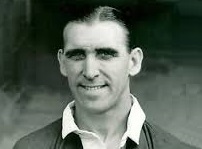
Len
Goulden |
West Ham United FC
14 appearances, 4 goals (1
on debut)
P 14 W 10 D 1 L 3 F
45:
A 22
75% successful
1937-39
captain: none
minutes played: 1260 |
|
 |
|
Profile |
|
Full name |
Leonard Arthur Goulden |
|
Born |
9 July 1912 in Hackney, London [registered in
Hackney, September 1912]. Raised in Plaistow.
Often stated as 16
July, which the 1939 register does. |
|
census notes |
According to the 1939
register, Leonard A. is a professional footballer, married to Irene, and
living at 159 Herent Drive in Ilford. |
|
Married |
to Irene D. Hamilton (b.1 May 1910)
[registered in
West Ham, Essex, June 1936].
Two sons, Roy L. (1937)
and Paul (1944). |
|
Died |
14 February 1995 in Plaistow, aged
82 years 221 days
[registered in Enfield, London, February 1995]. The death
registration states that Len's date of birth was 9th July 1912. |
|
Height/Weight |
5'
8", 10st.
2lbs [1938]. |
|
Source |
Douglas Lammings' An
English Football Internationalist Who's Who [1990] & FindMyPast.com |
|
Club Career |
|
Club(s) |
Began as a schoolboy in West Ham and was an
amateur with West Ham United FC in 1931, who sent him to Chelmsford FC and Leyton FC before he became a professional
back with the Hammers in 1933. And he remained at the Boleyn Ground until
the war. He guested for Chelsea FC during the war and signed for them
afterwards, in December 1945, for a £5000 transfer fee. He remained
at Stamford Bridge until his retirement, despite joining Chelmsford City
FC to manage in June 1949, but returned to Chelsea after receiving a
better offer. He retired a year later. |
|
Club honours |
None |
|
Individual honours |
Football League (two
appearances) |
|
Distinctions |
None |
|
Source |
Douglas Lammings' An English
Football Internationalist Who's Who [1990]. |
|
Management Career |
|
Club(s) |
On 8 June 1949, Goulden was appointed
secretary-manager of Southern League side, Chelmsford City FC. But after
a couple days, his present club, Chelsea, offered him lucrative terms to
stay at Stamford Bridge. The Chelmsford job went to Jack Tresadern.
Goulden remained at Chelsea FC and joined their
training staff, until he was appointed manager of Watford FC on 3 November
1952, appointed General Manager in October 1955 until February 1956, when
he dropped back down to just managing the team until July 1956. He
returned to Watford FC as coach in July 1959, until October 1962. Later
coached in Libya. Returned to coach Banbury United FC in 1965 until March
1965. Coached Oxford United FC from January 1969 for a period. |
|
England Career |
|
Player number |
One of three to become the
633rd
players (635) to appear for England. |
|
Position(s) |
Inside-left/right |
|
First match |
No. 209, 14 May 1937, Norway 0
England 6, an end-of-season tour match at Ullevål Stadion, Ullevål, Oslo, aged 24 years
309 days.
 |
|
Last match |
No.
226, 24 May 1939,
Romania
0 England 2,
an end-of-season tour match at Stadionul Agenţia Naţională de Educaţie Fizică, Bucureşti, aged 26 years 319 days.
|
|
Major tournaments |
British Championship
1937-38, 1938-39; |
|
Team honours |
British Championship winners
1937-38, shared 1938-39; |
|
Individual honours |
England wartime (four
appearances), England Schoolboy (two
appearances) |
|
Distinctions |
Len's son Roy, would also be an England
schoolboy international |
|
Beyond England |
|
Outside the game had worked as a
postmaster and at a Northamptonshire US Air Force base. -
An English Football Internationalists' Who's Who.
Douglas Lamming (1990). Hatton Press, p.110. |
|
Len Goulden - Career Statistics |
| Squads |
Apps |
comp. apps |
Mins. |
Goals |
goals ave.min |
comp. goals |
Capt. |
Disc. |
|
15 |
14 |
4 |
1260 |
4 |
315
min |
0 |
none |
none |
|
minutes are an approximation, due to the fact that many matches rarely stick to exactly ninety minutes long, allowing time for injuries and errors. |
|
Len Goulden
- Match Record - All Matches |
|
Type |
P |
W |
D |
L |
F |
A |
GD |
FTS
|
CS |
FAv |
AAv |
Pts% |
W/L |
|
Home |
3 |
3 |
0 |
0 |
10 |
5 |
+5 |
0 |
1 |
3.333 |
1.667 |
100.0 |
+3 |
|
Away |
11 |
7 |
1 |
3 |
35 |
17 |
+18 |
0 |
3 |
3.182 |
1.545 |
68.2 |
+4 |
| All |
14 |
10 |
1 |
3 |
45 |
22 |
+23 |
0 |
4 |
3.214 |
1.571 |
75.0 |
+7 |
|
Len Goulden
- Match Record - By Type of Match |
|
Type |
P |
W |
D |
L |
F |
A |
GD |
FTS |
CS |
FAv |
AAv |
Pts% |
W/L |
|
British Championship |
4 |
3 |
0 |
1 |
11 |
7 |
+4 |
0 |
0 |
2.75 |
1.75 |
75.0 |
+2 |
| Friendly |
9 |
7 |
1 |
2 |
34 |
15 |
+19 |
0 |
4 |
3.778 |
1.667 |
83.3 |
+5 |
| All |
14 |
10 |
1 |
3 |
45 |
22 |
+23 |
0 |
4 |
3.214 |
1.571 |
75.0 |
+7 |
|
Len Goulden
- Match Record - Tournament Matches |
|
British Championship Competition |
|
Type |
P |
W |
D |
L |
F |
A |
GD |
FTS |
CS |
FAv |
AAv |
Pts% |
W/L |
|
BC 1937-38 |
2 |
2 |
0 |
0 |
7 |
2 |
+5 |
0 |
0 |
3.50 |
1.00 |
100.0 |
+2 |
|
BC 1938-39 |
2 |
1 |
0 |
1 |
4 |
5 |
-1 |
0 |
0 |
2.00 |
2.50 |
50.0 |
=0 |
|
BC
All |
4 |
3 |
0 |
1 |
11 |
7 |
+4 |
0 |
0 |
2.75 |
1.75 |
75.0 |
+2 |
|
All Competition |
|
Type |
P |
W |
D |
L |
F |
A |
GD |
FTS |
CS |
FAv |
AAv |
Pts% |
W/L |
|
BC |
4 |
3 |
0 |
1 |
11 |
7 |
+4 |
0 |
0 |
2.75 |
1.75 |
75.0 |
+2 |
|
All |
4 |
3 |
0 |
1 |
11 |
7 |
+4 |
0 |
0 |
2.75 |
1.75 |
75.0 |
+2 |
|
Len Goulden
- Match History |
|
Club: West Ham
United F.C. - 14 full appearances |
F.A. International
Select Committee - 14
full capsx
|
|
|
Age 24 |
|
1 |
209 |
14 May 1937 -
Norway
0 England 6,
Ullevål Stadion, Oslo |
tour |
AW |
Start
85 |
11 |
|
2 |
210 |
17 May 1937 -
Sweden
0 England 4,
Råsunda Fotbollstadion, Solna |
AW |
Start |
11 |
|
- |
211 |
20 May 1937 -
Finland
0 England 8,
Töölön pallokenttä, Helsinki |
AW |
reserve |
|
Age 25 |
|
3 |
212 |
23 October 1937 -
Ireland
1 England 5,
Windsor Park, Belfast |
BC |
AW |
Start |
10 |
|
4 |
213 |
17 November 1937 -
England 2
Wales
1,
Ayresome Park, Middlesbrough |
HW |
Start |
10 |
|
5 |
214 |
1 December 1937 -
England 5
Czechoslovakia
4,
White
Hart Lane, Tottenham |
Fr |
HW |
Start |
10 |
|
6 |
216 |
14 May 1938 -
Germany
3
England 6,
Olympiastadion, Berlin |
tour |
AW |
Start
85 |
il |
|
7 |
217 |
21 May 1938 -
Switzerland
2 England 1,
Hardturm Stadion, Zürich |
AL |
Start |
il |
|
8 |
218 |
26 May 1938 -
France
2 England 4,
Stade Olympique Yves-du-Manoir, Paris |
AW |
Start |
il |
|
Age 26 |
|
9 |
219 |
22 October 1938 -
Wales
4 England 2,
Ninian Park, Cardiff |
BC |
AL |
Start |
10 |
|
10 |
220 |
26 October 1938 -
England 3
Rest
of Europe 0,
Arsenal
Stadium, Highbury |
Fr |
HW |
Start
73 |
10 |
|
11 |
223 |
15 April 1939 -
Scotland
1
England 2,
Hampden Park,
Glasgow |
BC |
AW |
Start |
10 |
|
12 |
224 |
13 May 1939 -
Italy 2
England 2,
Stadio Civico San Siro, Milano |
tour |
AD |
Start |
10 |
|
13 |
225 |
18 May 1939 -
Yugoslavia
2 England 1,
Stadion Beogradski
SK, Beograd |
AL |
Start |
10 |
|
14 |
226 |
24 May 1939 -
Romania
0 England 2,
Stadionul
ANEF, Bucureşti |
AW |
Start
8 |
8 |
Notes
Len Goulden was
a captivating footballer, a richly creative inside-forward whose flowing
skills earned him a regular place in the England side for two years before
the Second World War. But for the conflict, it is probable that the genial
Londoner would have added considerably to his tally of 14 appearances. Indeed, a
telling measure of Goulden's stature is that his international honours
were won when he was a player with West Ham United, then in the middle
reaches of the Second Division. He specialised in switching the point of
attack, suddenly and dramatically, with raking left-foot passes that could
render helpless several opponents at a stroke.
Born in Hackney and raised in Plaistow, Goulden progressed rapidly
as a teenager, winning selection for England schoolboys in 1926 and
joining the Hammers as an amateur five years later. As was then the
custom, he was farmed out to gain experience with local non-league
clubs, in his case Chelmsford and Leyton, before turning professional
at Upton Park in the spring of 1933. So eyecatching was Goulden's
talent that he was pitchforked immediately into senior action,
emerging as his team's star performer for the remainder of the decade.
Yet despite Goulden's frequently brilliant efforts, West Ham failed
to gain promotion, and his only club honour was a Football League
wartime cup medal, received for his part in victory over Blackburn
Rovers at Wembley in 1940. There was stirring consolation in his
country's colours, beginning with a scoring debut in the 6-0 thrashing
of Norway in Oslo in 1937 and ending prematurely with the outbreak of
war in 1939.
After the hostilities, during which he served in the police force,
Goulden realised, then 33, that if he was to sample life in the First
Division he would have to forsake the Hammers. Accordingly in 1945 he
joined Chelsea in a £5,000 deal.
At Stamford Bridge, Goulden spent five largely fulfilling seasons,
including a two-year stint fashioning bullets for the great
centre-forward Tommy Lawton to fire and a later productive spell as a
wing-half. Sadly, though, his trophy cabinet remained devoid of
medals, the nearest he came to glory being an FA Cup semi-final defeat
by Arsenal in 1950.
That year Goulden retired as a player, joining the Chelsea coaching
staff before becoming boss of Watford in 1952. Alas, despite guiding
the Hornets to fourth place in the Third Division (South) in 1954, he
proved too easy going for management and was dismissed in 1956. There
followed three years as a sub post master before a three-season return
to Watford as part-time coach, two years passing on his knowledge in
Libya and a spell in charge of non-league Banbury Town. A final
coaching post with Oxford Utd in 1969 signalled his farewell to the
game. Thereafter he worked on a USA Air Force base in Northamptonshire before retiring to Cornwall. Goulden, whose son Roy
played briefly for Arsenal and Southend Utd, will be remembered as one
of England's most cultured schemers and a humourous, immensely popular
man. - The Independent Obituary
____________________
CG
|
|
 England
Football Online
England
Football Online