|
|
|
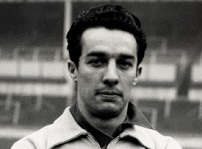
Ronnie
Allen |
West Bromwich Albion
FC
5 appearances, 2 goals
P 5 W 4 D 0 L 1 F 13:
A 6
80% successful
1952-58
captain: none
minutes played: 450 |
 |
|
Timeline |
| |
Ronald Allen |
|
Birth |
15 January 1929
in Fenton, Stoke-on-Trent, Staffordshire [registered in Stoke on Trent, March 1929].
Attended Hanley High School |
|
Death |
9 June 2001 in
Hardwick Court Nursing Home, Great Wyrley, Staffordshire, suffering
with Alzheimer's Disease, aged 72 years 146 days. [registered in South
Stafford, June 2001] |
|
Source |
 Douglas Lammings' An
English Football Internationalist Who's Who [1990] & Douglas Lammings' An
English Football Internationalist Who's Who [1990] & |
|
Biographies |
It's Goals
That Count - Ronnie Allen. (StanleyPaul, 1955) |
| |
Scoring
for Port Vale and West Bromwich Albion was just a matter of routine by the
time this book was published - good coverage of both clubs.
- A Football Compendium, Peter J. Seddon (1999). |
| |
The Complete Footballer: The Ronnie Allen Story
- Tony Matthews (2005). |
|
Club Career |
|
Club(s) |
Played his
junior football with Bucknall Boys Bridgade, Wellington Scouts and
Northwood Mission in Handly. Joined Port
Vale FC as an amateur in December 1944, turning professionally in March
1946 and made 123 league appearances, scoring 34 league goals. Signed for West Bromwich Albion FC
on 2 March 1950 for £18,000, going onto make 405 league appearances,
with 208 league goals. Joined
Crystal Palace FC in May 1961, another 100 league appearances
followed, along with 34 league goals. Spent the 1964-65 season as player-coach, retiring from playing in March
1965. Ending his career with a total of 276 league goals in 638 league
appearances. |
|
Club honours |
FA Cup winner
1953-54; |
|
Individual honours |
Football League
(one appearance) |
|
Distinctions |
First Division
Top Scorer 1954-55 (27). |
|
Height/Weight |
4' 10", 7st
10lbs [1944], 5' 8", 11st [1950], 5' 8", 10st 9lbs
[1957]. |
|
Source |
Douglas Lammings' An
English Football Internationalist Who's Who [1990]. |
|
Management Career |
,%20Ronnie.jpg) |
Club(s): Joined
Wolverhampton Wanderers FC as senior coach in March 1965, under Andy
Beattie. Took over as manager in September 1965, sacked in November
1968, after bringing them into the First Division. AC Bilbao in
Spain on 1
March 1969 until November 1971, SC de Portugal in Portugal in April 1973, Walsall
FC July to December 1973,
West Bromwich Albion FC consultant from January 1977, taking over as
manager from the June, until January 1978. Then national coach of
Saudi Arabia 1978, PanAthínaikos FC 1980, West Bromwich Albion FC 1981-82
(general manager 1982-83), remained coach with Albion in some capacity
until 1996. |
|
Club honours: Cope del Rey
winner 1968-69; La Liga runner-up 1969-70. |
|
England Career |
|
Player number |
717th player to
appear for England |
|
Position(s) |
Outside-right,
Centre-forward |
|
First match |
No. 272, 28 May 1952,
Switzerland
0 England 3, a friendly match at Hardturm Stadion, Zürich,
aged 23 years 134 days. |
|
Last match |
No. 293, 1 December 1954, England 3 West
Germany 1, a friendly match at Empire
Stadium, Wembley, London,
aged 25 years 320 days.  |
|
Major tournaments |
World Cup
Finals
1954 (provisional party), 1958 (provisional party);
British
Championship 1953-54, 1954-55; |
|
Team honours |
British
Championship winners 1953-54, 1954-55; |
|
Individual honours |
England B
(two appearances, 1954) |
|
Distinctions |
None |
|
Beyond England |
|
Remained with the West Bromwich Albion
set-up, remaining a part-time coach until 1996. - Media |
|
The Numbers |
|
parties |
Apps |
comp. apps |
unused |
minutes |
|
goals ave.min |
comp. goals |
 |
captain |
|
8 |
5 |
2 |
four |
450 |
2 |
225 min |
1 |
one |
none |
|
minutes are an approximation, due to the fact that many matches rarely stick to exactly ninety minutes long, allowing time for injuries and errors. |
|
P |
W |
D |
L |
F |
A |
GD |
FTS
|
CS |
FAv |
AAv |
Pts% |
W/L |
|
5 |
4 |
0 |
1 |
13 |
6 |
+7 |
1 |
0 |
2.6 |
1.2 |
80 |
+3 |
Venue Record
|
Venue |
P |
W |
D |
L |
F |
A |
GD |
FTS
|
CS |
FAv |
AAv |
Pts% |
W/L |
|
Home |
2 |
2 |
0 |
0 |
6 |
3 |
+3 |
0 |
0 |
3.00 |
1.50 |
100.0 |
+2 |
|
Away |
3 |
2 |
0 |
1 |
7 |
3 |
+4 |
1 |
0 |
2.333 |
1.00 |
66.7 |
+1 |
Competition Record
|
Competition |
P |
W |
D |
L |
F |
A |
GD |
FTS |
CS |
FAv |
AAv |
Pts% |
W/L |
|
WCP
|
1 |
1 |
0 |
0 |
4 |
2 |
+2 |
0 |
0 |
4.00 |
2.00 |
100.0 |
+1 |
| World Cup |
1 |
1 |
0 |
0 |
4 |
2 |
+2 |
0 |
0 |
4.00 |
2.00 |
100.0 |
+1 |
|
British Championship |
2 |
2 |
0 |
0 |
7 |
4 |
+3 |
0 |
0 |
3.50 |
2.00 |
100.0 |
+2 |
|
The 1953-54
records of the World Cup preliminaries and British Championship are
duplicated, and one set is deducted from the grand total. |
| Friendly |
3 |
2 |
0 |
1 |
6 |
2 |
+4 |
1 |
0 |
2.00 |
0.667 |
66.7 |
+1 |
Tournament Record
|
World Cup Preliminary Competition |
|
Type |
P |
W |
D |
L |
F |
A |
GD |
FTS |
CS |
FAv |
AAv |
Pts% |
W/L |
|
WCP/BC 1953-54 |
1 |
1 |
0 |
0 |
4 |
2 |
+2 |
0 |
0 |
4.00 |
2.00 |
100.0 |
+1 |
|
WCP All |
1 |
1 |
0 |
0 |
4 |
2 |
+2 |
0 |
0 |
4.00 |
2.00 |
100.0 |
+1 |
|
British Championship Competition |
|
Type |
P |
W |
D |
L |
F |
A |
GD |
FTS |
CS |
FAv |
AAv |
Pts% |
W/L |
|
BC/WCP 1953-54 |
1 |
1 |
0 |
0 |
4 |
2 |
+2 |
0 |
0 |
4.00 |
2.00 |
100.0 |
+1 |
|
BC 1954-55 |
1 |
1 |
0 |
0 |
3 |
2 |
+1 |
0 |
0 |
3.00 |
2.00 |
100.0 |
+1 |
|
BC All |
2 |
2 |
0 |
0 |
7 |
4 |
+3 |
0 |
0 |
3.50 |
2.00 |
100.0 |
+2 |
|
All Competition |
|
Type |
P |
W |
D |
L |
F |
A |
GD |
FTS |
CS |
FAv |
AAv |
Pts% |
W/L |
|
WC |
1 |
1 |
0 |
0 |
4 |
2 |
+2 |
0 |
0 |
4.00 |
2.00 |
100.0 |
+1 |
|
BC |
2 |
2 |
0 |
0 |
7 |
4 |
+3 |
0 |
0 |
3.50 |
2.00 |
100.0 |
+2 |
The 1953-54
records of the World Cup preliminaries and British Championship are
duplicated, and one set is deducted from the grand total.
|
2 |
2 |
0 |
0 |
7 |
4 |
+3 |
0 |
0 |
3.50 |
2.00 |
100.0 |
+2 |
Match History
|
Club:
West Bromwich Albion F.C.
- five full appearances (450 min) 2ᵍ |
manager: Walter
Winterbottom - five full appearances
(450 min) 2ᵍx |
|
apps |
match |
pic |
match details |
comp |
res. |
rundown |
shirt |
|
1 May 1954 was the date set by FIFA for
a list of forty names to be submitted, from which the final 22 could be
selected for each country's World Cup party. England's list appeared on 22 April
1954, nine days ahead of the deadline. 18 were destined not to make the final
cut, including Ronnie Allen. |
|
England's selectors
announced their forty-man party from whom the final 22 would be
selected, on April 22 1958. The 18 players who failed to make the cut on
May 28 included, once again, Ronnie Allen. |
|
|
 England
Football Online
England
Football Online