|
|
|
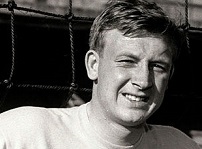
Eddie
Hopkinson |
Bolton Wanderers FC
14 appearances,
24 goals against
4 clean sheets,
1 penalty conceded
P 14 W 6 D 2 L 6 F 32:
A 24
50% successful
1957-59
captain: none
minutes played: 1260 |
|
 |
|
Timeline |
| |
Edward Hopkinson |
|
Birth |
29 October 1935 in Wheatley Hill, County Durham [registered in
Easington, December 1935].
Attended Bryon Street School and
Royton Secondary Modern School, Royton |
|
Death |
25 April 2004 in Royton, Lancashire, aged
68 years 179 days
[registered in Oldham, April 2004]. |
|
Source |
Douglas Lammings' An
English Football Internationalist Who's Who [1990] &
 |
|
Biographies |
x |
|
x.
- A Football Compendium, Peter J. Seddon (1999). |
|
Club Career |
|
Club(s) |
x |
|
Club honours |
x |
|
Individual honours |
x |
|
Distinctions |
x |
|
Height/Weight |
5'
8¾", 11st.
7lbs [1959]. |
|
Source |
Douglas Lammings' An English
Football Internationalist Who's Who [1990]. |
|
England Career |
|
Player number |
One of three
who became the 761st players (761) to appear for England. |
|
Position(s) |
Goalkeeper; 78th goalkeeper to appear. |
|
First match |
No. 315, 19 October 1957, Wales 0 England 4,
a British Championship match at Ninian Park, Sloper Road, Cardiff, aged 21 years
355 days. |
|
Last match |
No. 336, 28 October 1959, England 2 Sweden 3,
a friendly match at The Empire Stadium, Wembley Park, London, aged 23 years 364 days. |
|
Major tournaments |
World Cup
Finals 1958; British
Championship 1957-58, 1958-59, 1959-60; |
|
Team honours |
British
Championship shared 1957-58, 1958-59, 1959-60; |
|
Individual honours |
England B
(three appearances, May 1957), England U23 (three
appearances, 1957-59) |
|
Distinctions |
Became the
youngest goalkeeper (22 years 8 days) to
face a penalty kick on 6 November 1957. |
|
Beyond England |
|
x. -
An English Football Internationalists' Who's Who.
Douglas Lamming (1990). Hatton Press, p.x. |
|
The Numbers |
|
parties |
Apps |
Comp
Apps |
reserve |
minutes |
GA |
GA Av.
min |
Comp GA |
Clean
Sheets |
Cln
Sht Av |
cln sht best |
capt. |
|
11 |
14 |
5 |
2 |
1260 |
24 |
53
min |
4 |
4 |
29% |
248 min |
none |
|
minutes are an approximation, due to the fact that many matches rarely stick to exactly ninety minutes long, allowing time for injuries and errors. |
|
P |
W |
D |
L |
F |
A |
GD |
FTS
|
CS |
FAv |
AAv |
Pts% |
W/L |
|
14 |
6 |
2 |
6 |
32 |
24 |
+8 |
2 |
4 |
2.286 |
1.714 |
57.1 |
=0 |
Venue Record
|
Venue |
P |
W |
D |
L |
F |
A |
GD |
FTS
|
CS |
FAv |
AAv |
Pts% |
W/L |
|
Home |
6 |
3 |
1 |
2 |
13 |
9 |
+4 |
0 |
2 |
2.167 |
1.50 |
58.3 |
+1 |
|
Away |
8 |
3 |
1 |
4 |
19 |
15 |
+4 |
2 |
2 |
2.375 |
1.875 |
43.8 |
-1 |
Competition Record
|
Competition |
P |
W |
D |
L |
F |
A |
GD |
FTS |
CS |
FAv |
AAv |
Pts% |
W/L |
|
British Championship |
5 |
3 |
1 |
1 |
12 |
4 |
+8 |
0 |
3 |
2.40 |
0.80 |
70.0 |
+2 |
| Friendly |
9 |
3 |
1 |
5 |
20 |
20 |
=0 |
2 |
1 |
2.222 |
2.222 |
38.9 |
-2 |
Tournament Record
|
British Championship Competition |
|
Type |
P |
W |
D |
L |
F |
A |
GD |
FTS |
CS |
FAv |
AAv |
Pts% |
W/L |
|
BC 1957-58 |
3 |
2 |
0 |
1 |
10 |
3 |
+7 |
0 |
2 |
3.333 |
1.00 |
66.7 |
+1 |
|
BC 1958-59 |
1 |
1 |
0 |
0 |
1 |
0 |
+1 |
0 |
1 |
1.00 |
0.00 |
100.0 |
+1 |
|
BC 1959-60 |
1 |
0 |
1 |
0 |
1 |
1 |
=0 |
0 |
0 |
1.00 |
1.00 |
50.0 |
=0 |
|
BC
All |
5 |
3 |
1 |
1 |
12 |
4 |
+9 |
0 |
3 |
2.40 |
0.80 |
70.0 |
+2 |
|
All Competition |
|
Type |
P |
W |
D |
L |
F |
A |
GD |
FTS |
CS |
FAv |
AAv |
Pts% |
W/L |
|
BC |
5 |
3 |
1 |
1 |
12 |
4 |
+8 |
0 |
3 |
2.40 |
0.80 |
70.0 |
+2 |
|
5 |
3 |
1 |
1 |
12 |
4 |
+8 |
0 |
3 |
2.40 |
0.80 |
70.0 |
+2 |
Match History
|
Club:
Bolton Wanderers F.C. - fourteen full appearances
(1260 min) 24ᵍᵃ |
manager:
Walter Winterbottom - fourteen
full appearances (1260 min) 24ᵍᵃx |
|
|
apps |
match |
pic |
match details |
comp |
res. |
rundown |
shirt |
|
7 |
329 |
11 April
1959 - England 1 Scotland 0
Empire Stadium, Wembley |
BC |
HW |
|
1 |
|
8 |
330 |
6 May 1959 - England 2 Italy 2
Empire Stadium,
Wembley |
Fr |
HD |
|
1 |
|
ᵍᵃlob
& angled |
|
9 |
331 |
13 May 1959 - Brazil 2 England 0
Estádio Municipal, Rio |
tour |
AL |
|
1 |
|
ᵍᵃflashed
& whistled |
|
10 |
332 |
17 May 1959 - Peru 4 England 1
Estadio Nacional Coloso de José Díaz,
Lima |
AL |
|
1 |
|
ᵍᵃ18yd,
save, jab & tap |
|
11 |
333 |
24 May 1959 - Mexico 2 England 1
Estadio Olímpico Universitario,
Ciudad de México |
AL |
|
1 |
|
ᵍᵃheader
& close |
|
12 |
334 |
28 May 1959 - United States 1 England 8
Wrigley Field, Los Angeles |
AW |
|
1 |
|
ᵍᵃshot |
|
13 |
335 |
17 October 1959 Wales 1 England 1
Ninian Park, Cardiff |
BC |
AD |
|
1 |
|
ᵍᵃheader |
|
14 |
336 |
28 October 1959 - England 2 Sweden 3
Empire Stadium, Wembley |
Fr |
HL |
|
1 |
|
ᵍᵃheader,
18yd & 12yd |
|
|
|
|
 England
Football Online
England
Football Online