|
England's Emblems:
Origins and Evolution |
 Three
Lions on a
Shirt Three
Lions on a
Shirt
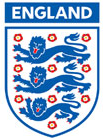
The Three Lions
We can probably trace the
origins of the Football Association’s emblem for the England team back
to biblical times. The lion might seem a strange choice of animal as a
heraldic symbol for a country in northern Europe. Nowadays, we think of
lions as being native to Africa. Cameroon’s national team are known as
the Indomitable Lions. Yet, ten thousand years ago, this majestic beast
was the most widely spread land mammal after humans, and occupied much
of western Europe.
Lions (and also leopards) are believed to have
evolved from jaguars over a million years ago and humans have long
regarded them as strong, but noble beasts to be feared. They are kings
of all they survey and they provided inspiration for biblical royalty to
portray themselves as ‘brave lions’. To emphasize this, they were
immortalised in paintings, statues, entrances and emblems at the command
of royalty. The lion was the emblem of the Kingdom of Judah and is
mentioned in the Book of Genesis as “the king of beasts”.
So, it was a long held tradition for kings, and those
who felt that they should be king, to use the lion to promote themselves
in a very early form of marketing. By the time of the eleventh century, this form of
heraldry extended to the nobility creating their own Coats of Arms.
William the Conqueror brought the arms of the House of Normandy to the
throne of England. This depicted two lions on a red background.
William’s son, Henry became King in 1100. Henry I was
keen to build strong bonds between the Houses of Normandy and Anjou. His
daughter, Matilda, was allowed to marry the ruler of Anjou; Geoffrey, in
1127. Henry presented his new son-in-law with an azure shield depicting
four gold lions, no doubt symbolic of the coming together of two
dynasties.
On Henry’s death in 1135, a bitter struggle ensued
for the throne. Stephen, Matilda’s cousin became King. Matilda was never
crowned, but her son, Henry took on the fight on his mother’s behalf. In
1152, he married Eleanor, the Duchess of Aquitaine and added the single
lion from the Aquitaine Court of Arms to the two on the House of
Normandy Arms. The Three Lions were born!
This marriage meant Henry acquired vast lands and his
new powers gave him the momentum to lay claim to the throne of England.
Stephen’s son and heir had died and he was forced to concede the
monarchy to his cousin’s son, who became Henry II on Stephen’s death, in
1154.
The new King named his house Plantagenet, after his
father’s nickname, and also created the first Coat of Arms for the
English monarchy. Although the Normandy Arms had two lions and the new
Plantagenet Arms had three, the first royal coat had just a single lion.
Henry died in 1189 and was succeeded by his son,
Richard the Lionheart, who added a second lion to the royal coat to
match that of the House of Normandy, one of the titles he had inherited.
In 1198, just a year before his death, the third lion was added. Why he
chose to do this at that time is unclear, but his crusades certainly
helped associate his name with that of the lion, and it meant that, at
last, the royal coat was aligned to that of the House of Plantagenet.
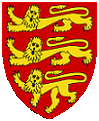
From this point onwards, the Three Lions would remain
the symbol of the crown of England and, ultimately, representing England
in the United Kingdom’s Royal Coat of Arms. Today, there are many
examples of symbolic lions reminding us of their place in our history.
In London’s Trafalgar Square, for example, there are four huge bronze
lions protecting Nelson’s Column.
The blazon (official description) for the Three Lions
that were introduced by King Richard is:
‘Gules in pale three lions
passant guardant or’
‘Gules’ means ‘red’.
‘in pale’ means they
are on a central, vertical axis.
‘passant’ means head to
the left, body horizontal, with three legs on the ground, right front leg
stretched forward and tail reflexed back over the body.
‘guardant’ means head
facing out to the observer.
‘or’ means gold or
yellow.
There is a suggestion that the lions are actually
leopards. This is because in the original French blazon terminology, a ‘lion
passant guardant’ is referred to as ‘leopard’, but this is intended
to describe the animal’s posture, rather than the species. In all
English heraldry interpretations, these are definitely lions.
The term ‘Three Lions’ was barely used until
David Baddiel, Frank Skinner and the Lightning Seeds wrote and recorded
a song to sum up what it was like to be an England fan in the years
since the World Cup triumph of 1966; ‘Three lions on a shirt, Jules
Rimet still gleaming, thirty years of hurt, never stopped me dreaming',
perfectly capturing the mood of the fans at the European Championships,
held in England in 1996. The single was a smash hit and established the
term, ‘wearing the Three Lions’ as a reference to the pride of playing
for England.
The Tudor Roses
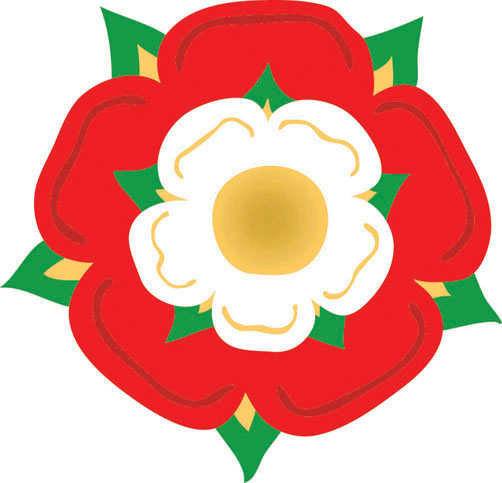 King Henry VII was responsible for the creation of
the Tudor Rose, having ended the War of the Roses in 1485, by taking the
crown from Richard III in battle. He married Elizabeth of York, the
following year, and celebrated by amalgamating the Red Rose of
Lancaster, with the White Rose of York. As the first Tudor King, he
introduced the rose as the heraldic floral emblem of England and a
symbolic unification of the two factions in the war. King Henry VII was responsible for the creation of
the Tudor Rose, having ended the War of the Roses in 1485, by taking the
crown from Richard III in battle. He married Elizabeth of York, the
following year, and celebrated by amalgamating the Red Rose of
Lancaster, with the White Rose of York. As the first Tudor King, he
introduced the rose as the heraldic floral emblem of England and a
symbolic unification of the two factions in the war.
The Adoption and Usage by the Football
Association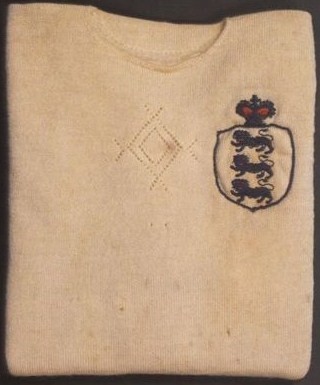
The first emblem of the England football team was
worn in the world’s very first international match, in 1872, against
Scotland, in Glasgow. It consisted of three lions within a shield, in a
similar stance to that of the English Coat of Arms, except that these
lions were navy blue and the only distinguishable features were red eyes
and mouths. A red and navy crown sat upon the top of the shield.
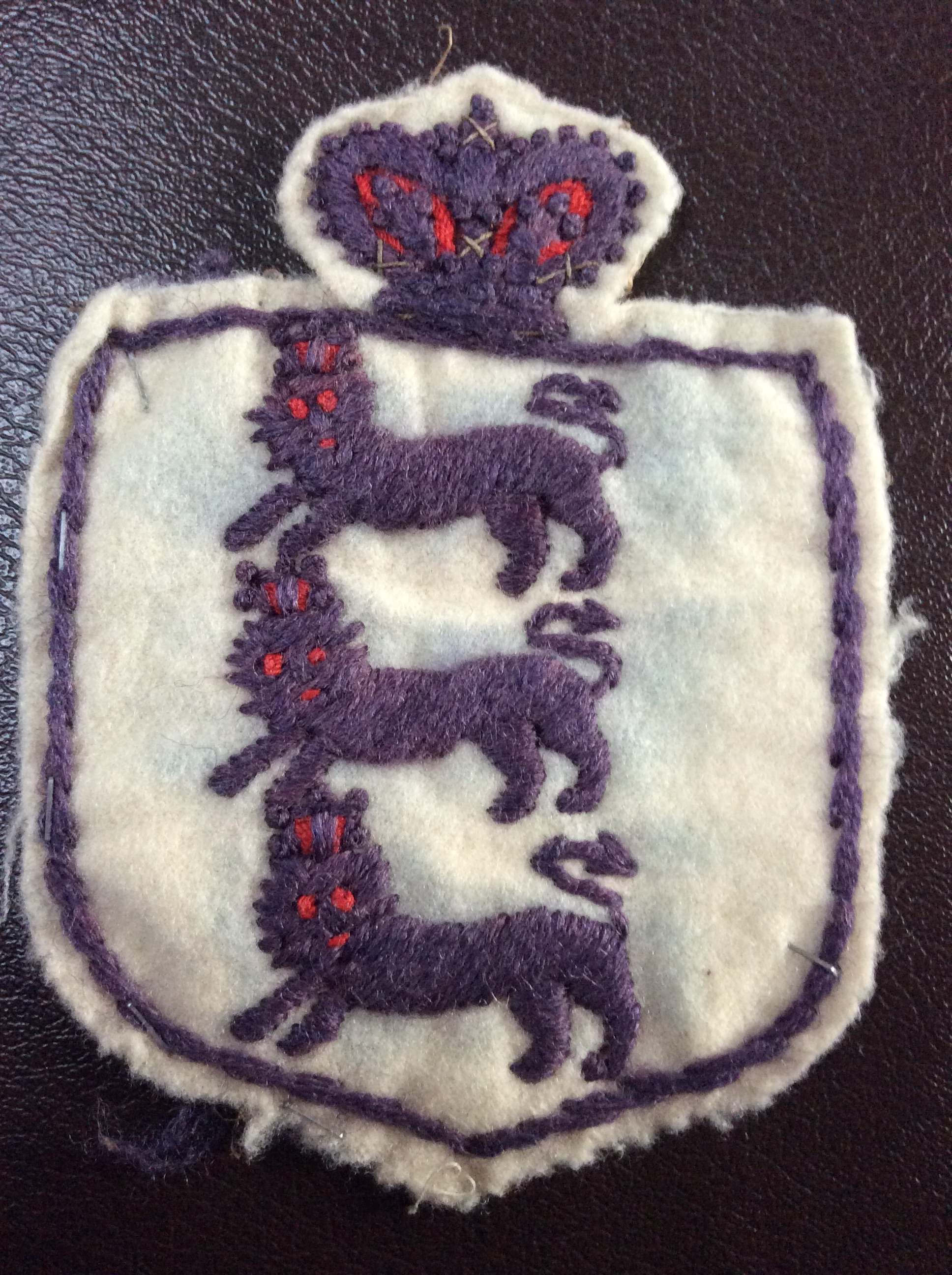 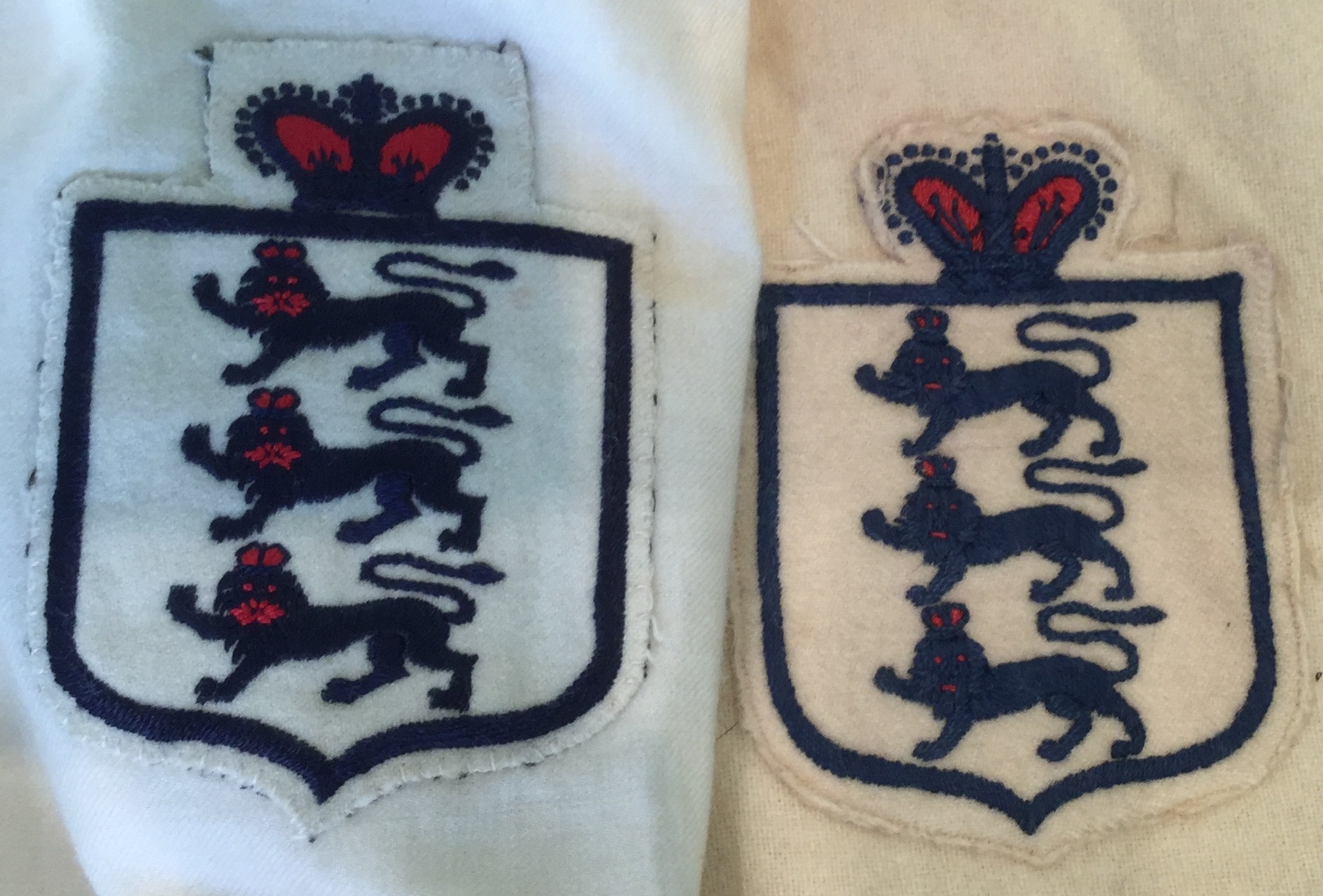 
Designs were
quite rudimentary at first. The example above left was used in the early
1890s and shows both front legs pointing downwards (not 'passant').
Around
the turn of the century, the badge was narrowed, making the lions
appear more upright and realistic, and the crown on top was also made
smaller. A further change saw small red crowns placed on the heads of each of
the lions. Then, before the Second World War, red whiskers were
added to the design, before being enhanced after the war. The two
examples above second left are from 1948 (left) and 1923 (right).
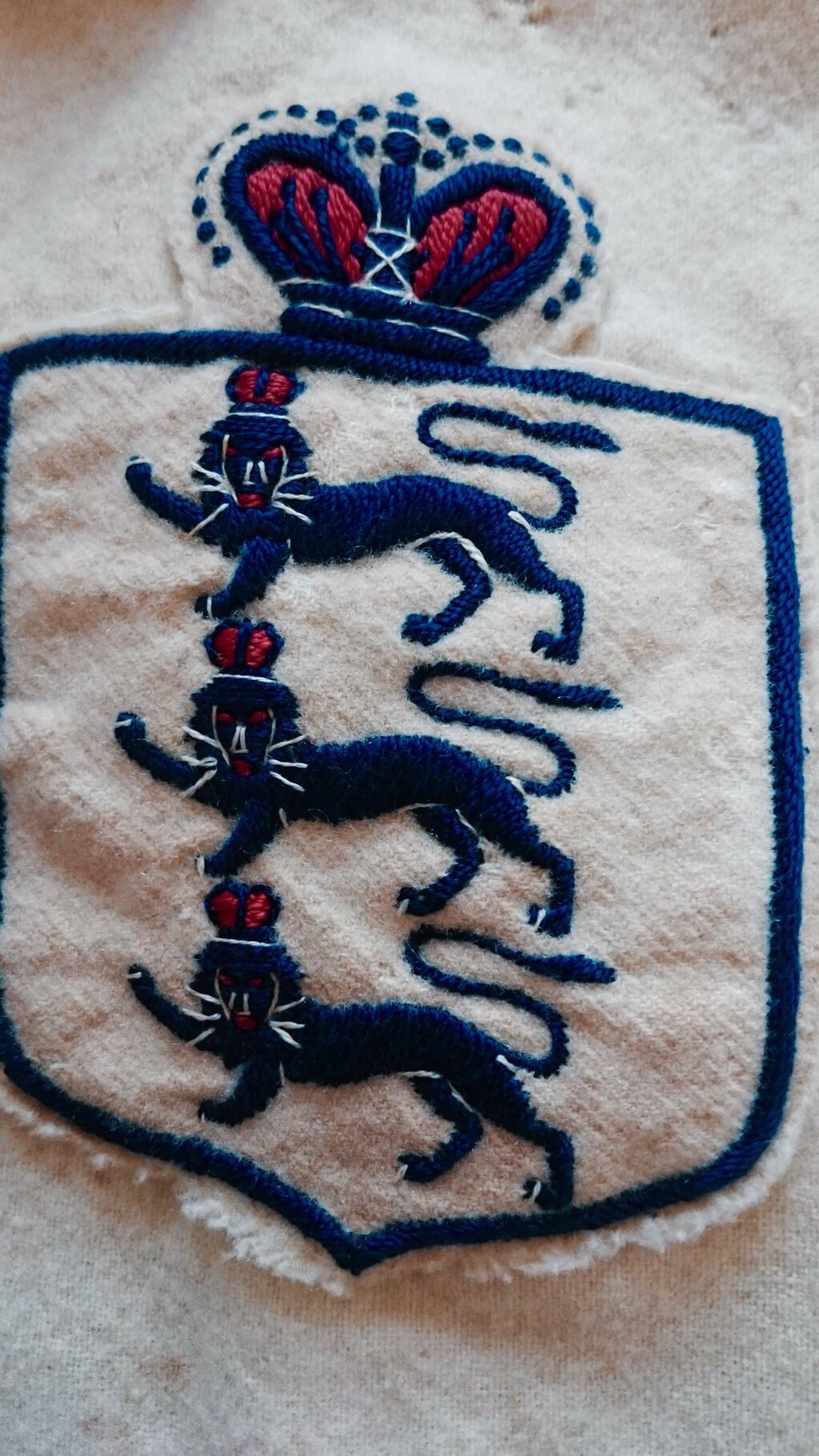
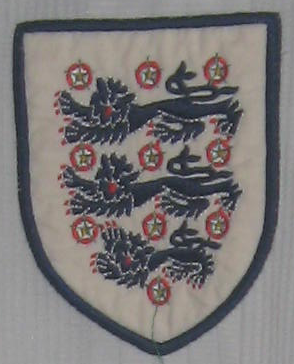
The fourth
example (above right) is from a shirt worn by David Jack in 1930. This
is a curious one, because the whiskers are white, and white thread
appears in various places around the design. Clearly, there were a
number of variations of the original design and we have yet to work out
whether there is a noticeable pattern to when each appeared.
|
England
Emblems From 1949 |
|
1949 |
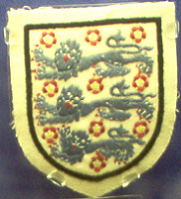 |
In a possible attempt to distinguish the badge from that
used by the England cricket team, a new emblem was designed by the
College of Arms. The lions were re-drawn with red claws and more
features, and the crowns were removed. Ten Tudor Roses were scattered around the
lions probably to represent the ten regional
divisions, each of which has a seat on the Football Association
Council. |
|
1950 |
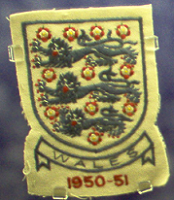 |
A revised design was introduced in
1950, incorporating an
additional eleventh Tudor Rose. This may have been as a result of
a change to the regional divisions of the FA, possibly connected
to the 1951 Festival of Britain. It may even have been
representative of the eleven members of a football team.
Unfortunately, nobody seems to know (including the FA). At the
same time, a scroll was introduced beneath the emblem to include
the name of England’s opponents for each match, in blue.
Underneath this was the season, in red. |
|
1953 |
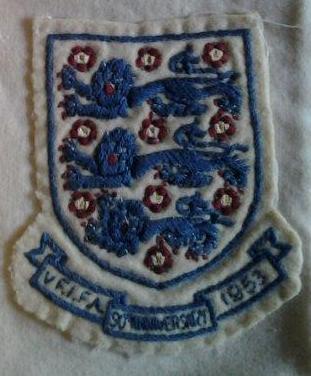 |
In 1953, a special commemorative
scroll was used for the FA's ninetieth anniversary match against
a side selected by FIFA from the rest of Europe. The scroll is
not easy to read, but says:
v F.I.F.A.
90TH
ANNIVERSARY 1953 |
|
1954 |
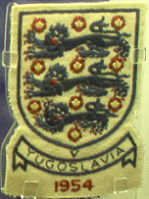 |
At the beginning of the
1951-52 season, a small blue ‘v’ had been added between the badge and the
scroll, as an abbreviation for
‘versus’. From the following season,
the shirts worn in friendly matches
only displayed the single year, rather
than the season. The shirts
worn against the other home
nations continued to display the season. |
|
1955 |
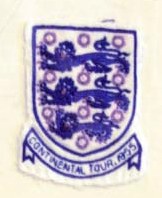 |
For each of the last three
games of the 1954-55 season, England omitted the opponents'
names from the scrolls and replaced them with CONTINENTAL TOUR,
1955. This, presumably, meant that the players had to wear the
same shirts in each game. The scrolls were then absent from the
shirts completely for the following season (1955-56). Perhaps,
this was so that they could re-use shirts to save costs, because
the players appear to have still been separately issued with the
emblems, including the scrolls. The scrolls returned for the
1956-57 season, but this was the last time that they would be
used for the British Championship matches, and the 1958 World
Cup games were also not included, as had been the case for the
two previous World Cup tournaments in the fifties.
They were worn for the
last time (in full internationals), at the end of the 1959-60 season,
though they were still used to distinguish shirts worn in
intermediate internationals (with words such as 'AMATEUR',
'YOUTH' and 'INTERMEDIATE' appearing inside the scrolls)
intermittently right
up until 1999. |
|
1963 |
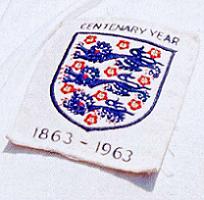 |
When the Football Association celebrated its
centenary, a commemorative emblem was worn in every
game during the calendar year of 1963. |
|
1966 |
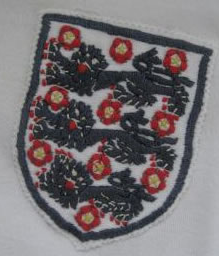 |
The lions appear to have turned a very dark shade
of blue as England were about to lift the World Cup. |
|
1970 |
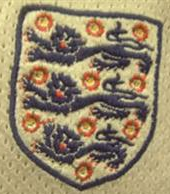 |
As they appeared on the lightweight aertex shirts worn
at
the World Cup in Mexico… |
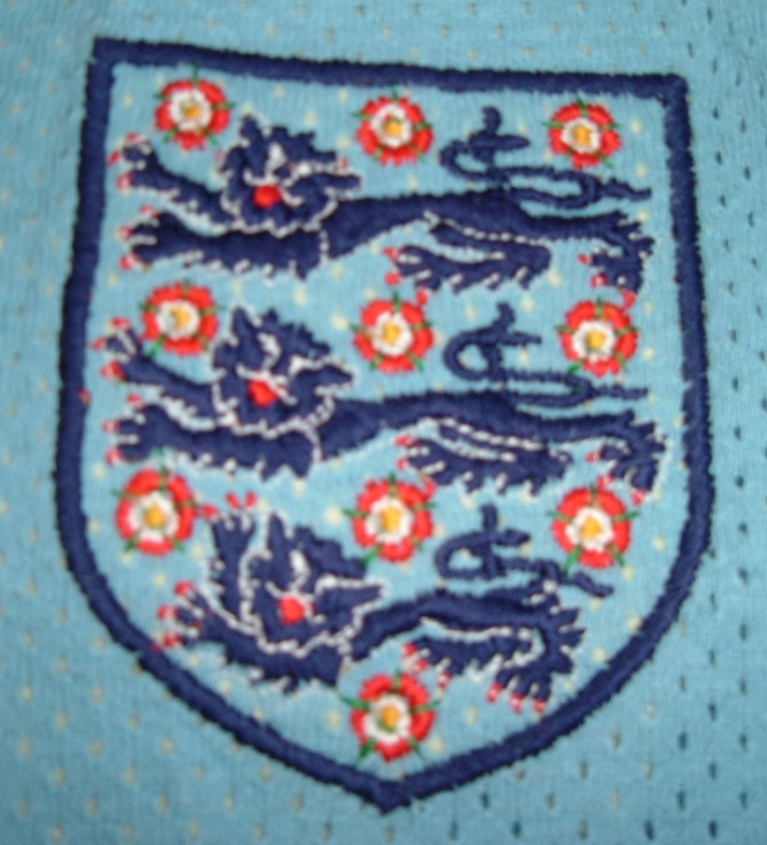 |
…but
against Czechoslovakia, the emblem had the same blue
background as the shirt, due to it being sewn into the shirt, as
opposed to being part of an embroidered patch. This was also the
case on the yellow goalkeeper's jersey, where the emblem had a
yellow background, but the emblem on the navy blue jersey, worn
against Brazil, was on a white background, because it would,
otherwise, have not stood out. |
|
1974 |
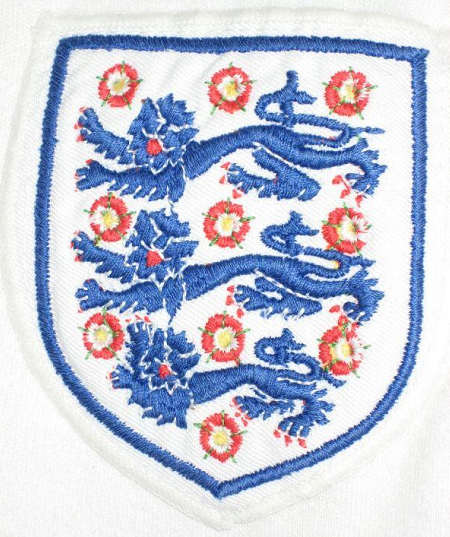 |
Admiral took on the role of England’s kit
manufacturer and a richer blue was used, matching the shade of blue
on the shorts. |
|
1982 |
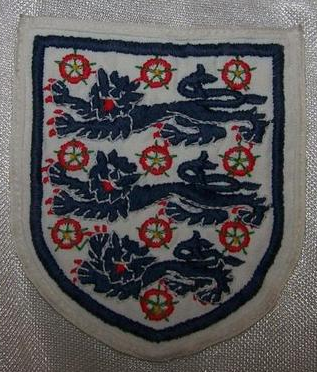 |
Admiral’s second England design brought the colour
of the lions back to a darker shade of blue, here for the World
Cup in Spain. For the World Cups of 1986, '90 and '98, and the
1992 European Championship, lettering was added underneath the
emblem to signify the tournament that the shirt was worn in.
These were as follows:
-
FIFA WORLD CUP MEXICO'86
-
FIFA WORLD CUP ITALY '90
-
EURO 92 SWEDEN
-
FIFA WORLD CUP FRANCE 1998
This practice was eventually
replaced by the addition of embroidered tournament logo patches
to the sleeves. |
|
1995 |
 |
A white margin was introduced around the motif and
the emblem was positioned centrally on the chest with 'UMBRO'
spelt out in large navy capitals above it. |
|
1997 |
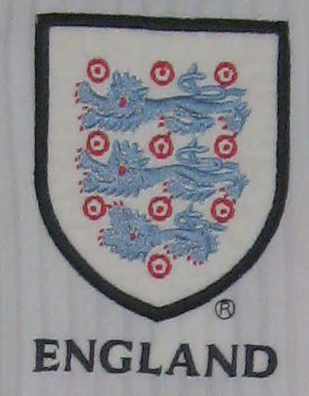 |
Several breaks in tradition as the lions changed to
a lighter shade of blue. The team name appeared underneath the
emblem and, most significantly, for the first time, the centres
of the roses were changed from yellow to red, and the
green petals were removed. The registered trademark (®) probably
gives us a clue as to the reason why. It
would be easier to reproduce a simpler red and white rosette on
merchandising. |
|
2000 |
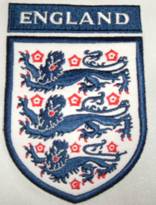 |
David Davies, the FA's Executive Director
in 1999, revealed, in his autobiography, that the lions' eyes
appeared to have closed. Changing the colour back to navy and
making the eyes more prominent meant that Davies 'skilfully'
avoided any suggestion that the FA were lacking vision! The other significant change was that
the team name found a new home above the emblem, thankfully
replacing the 'UMBRO' lettering. The emblem also returned to the
left breast. In 2005, a gold star was placed above it to
represent England's solitary World Cup win. |
|
2009 |
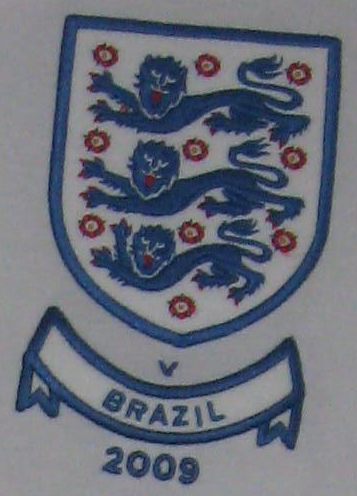 |
At long last, after years of criticism of Umbro's constant
tinkering with the design of the kit and changes to the
emblem, the FA finally relented and restored some of the
traditions held so dear to thousands of England fans. Not only
did the shirt revert back to plain white (apart from the
essential markings) for the first time since 1974, but they also
revived a 1954-style collar, whilst the emblem was larger
and much more
prominent, with the lions re-drawn to appear more distinctive in
a lighter blue. The outer roses down each side were re-positioned
closer to the edge to stand out better. It was also a
pleasant surprise to see that the green petals of the roses were
back and that their centres had changed from red, back to
yellow.
The star above it was changed to white and only
visible in close-up.
Finally, with a further nod to the fifties shirts, the scrolls with the opponents' name re-appeared underneath the
emblem. The year was displayed in red for a home game and blue
for away. |
|
2012 |
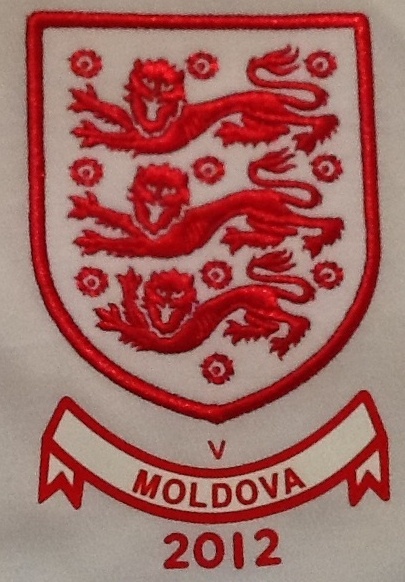 |
Another unexpected twist, as the emblem turned completely red
(as did the star above it), in keeping with the Cross of St.
George theme, with no navy blue at all on the kit. In truth, it
was the latest in a long line of different-coloured emblems that
had already featured on the shorts and on the goalkeeper's kit,
though often unnoticeable due to them being the same colour as
their background. These were as follows:
-
2009 - all-white emblem on the
white shorts.
-
2009 - all-green emblem on the
goalkeeper's green shorts.
-
2009 - all-blue emblem on the
blue shorts.
-
2010 - all-red emblem on the
white shorts.
-
2011 - all-green emblem on the
goalkeeper's green jersey.
|
|
2013 |
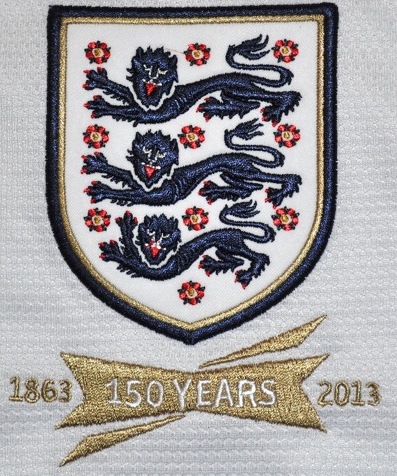 |
Having acquired Umbro, Nike then proceeded to take on the
England contract themselves, and produced two new kits to
commemorate the FA's 150th anniversary. They launched the new
white shirt at the end of May 2013. The scrolls were replaced by
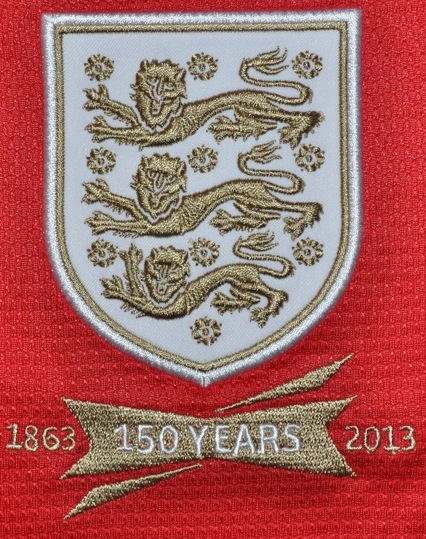
a gold ribbon and the emblem returned to full colour, but with
an additional inner gold border. Four days later, the red shirt
was worn for the first time, in Brazil, and the emblem was all
gold for the first time. The emblems on the two goalkeepers'
shirts were also co-ordinated, with a full-colour emblem on the
gold first-choice (worn alongside the white shirt in home
games), and a gold emblem on the green second-choice (worn
alongside the red shirt in away games). |
 |
|
2015 |
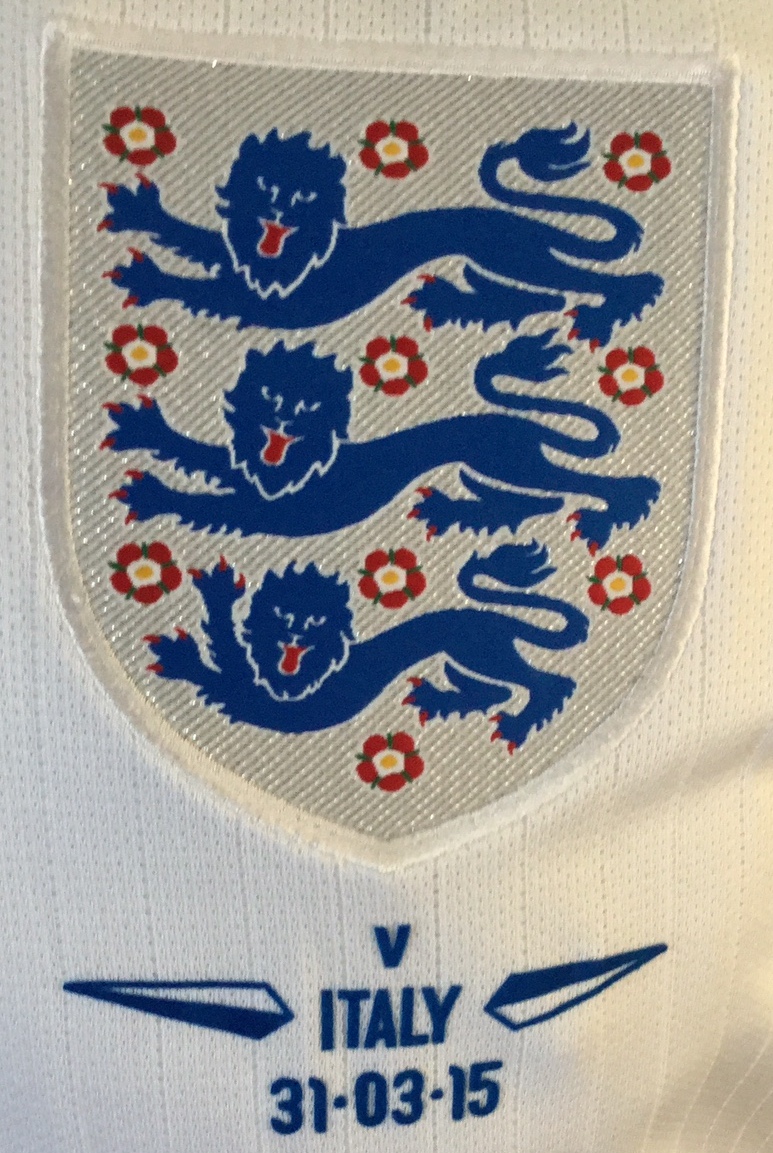 |
The lions were back to royal blue, but this time with a silver
star above the emblem. Nike resisted the practice of adding the
opponent's name in a scroll underneath until the 2014 World Cup,
when they came up with their own design (including the date) to
make each shirt unique once more. |
N.B. The Football Association have used the same
emblem as the England team since 1949, but often with a lighter
shade of blue.
____________________
GI/CG
|
 England
Football Online
England
Football Online