|
|
|
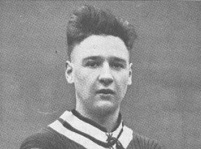
Eric
Houghton |
Aston Villa FC
7 appearances, 5 goals, 1
penalty missed
P 7 W 6 D 0 L 1 F
28:
A 12
86% successful
1930-32
captain: none
minutes played: 630 |
|
 |
|
Profile |
|
Full name |
William Eric Houghton |
|
Born |
29 June 1910 in Billingborough, Lincolnshire [registered in
Bourne, September 1910].
Attended Donington Grammar School |
|
School notes |
"Eric Houghton, of Billingborough, at the Grammar School sports at Donington
won the 100 yards handicap in 11sec., the 220 yards in 22 3-5th sec., the
440 yards, was second for throwing the cricket ball, second for the long
jump (17ft. 3½in.), second in the mile, and third for the high jump."
- Saturday, 13 August 1927, The Grantham Journal |
|
Census Notes |
According to the 1911
census, the nine month-old Eric is the
only child of George and Mary Ethel. His father is a baker and they live
in Billingborough High Street. |
|
According to the 1939 register, William E., a professional footballer and
a fish frier, is married to Muriel, and with one son, William (record
blocked), they live at Sandhurst Avenue, in the Hodgehill area of
Birmingham. |
|
Married |
to Muriel Trevor Cooke
(b.28 May 1914),
on 29 June 1936 at Blyborough Parish Church
[registered in Gainsborough, Lincolnshire, June 1936]. Eric, by
this time, was living at Rippingale, near Bourne. Muriel is an nurse at
Nottingham Eye Hospital.
"The
bride, whose father gave her away, wore a gown of heavy ivory lace, with
draped skirt of tulle, and headdress of ivory tulle to which was attached
a long veil and she carried cream roses. The two elder attendants were
colleagues of the bride, Miss Betty Mitchell, and Miss Elsie Summers. They
wore dresses of pale stiffened lace with crinoline hats to match and
carried pink carnations. The best man was Mr. Reg Goodacre, of
Billingborough, who has played for West Ham, and was with Gainsborough
Trinity last season. The honeymoon is being spent in a motor tour of the
South Coast." - Monday, 29
June 1936, The Lincolnshire Echo
They had four children, Robert E. (b.1937 d.4 April
1938), William N. (b.2 March 1939), Gillian M.
(b.24 November 1944) and Eric A. (b.1948).
Eric was
best man for Reg Goodacre when he married Jean Margaret Crosby on 27
September 1941. |
|
Died |
1 May 1996 in Sutton Coldfield, aged
85 years 307 days
[registered in Lichfield, Staffordshire, May 1996]. |
|
Height/Weight |
5'
8¼", 11st.
10lbs [1938]. |
|
Source |
Douglas Lammings' An
English Football Internationalist Who's Who [1990] & FindMyPast.com |
|
Club Career |
|
Club(s) |
Began his
playing career at Billingborough FC and Boston Town FC, before he signed for Aston
Villa FC as an amateur on 24 August 1927 following a trial match, turning professional in August
1928, but not before playing for Birmingham FA juniors. He guested for
Leicester City FC and the RAF, where he was stationed, then Nottingham
Forest FC and Cventry City FC, during the war. Houghton would make 361 league appearances
for Villa, amassing 160
goals, up until 27 December 1946, when he joined Notts County FC and
made a further 55 league appearances, scoring ten goals,
until he hung up his boots on 25 May 1949 to become the club manager. |
|
Club honours |
Football League
runners-up 1930-31, 1932-33; Division Two winners 1937-38; |
|
Individual honours |
Football League (four appearances) |
|
Distinctions |
In May 1927, while still a Billingborough lad, Houghton
"received a chequed for £55, part share of the
£1,000 offered by a Sunday paper." for
"forecasting the score and the correct number
of spectators passing through the gates at Wembley for the English Cup
Final."
Houghton
also played seven first-class matches for Warwickshire CCC
and also minor counties cricket for Lincolnshire CCC. He
also played club cricket for Sleaford, Aston Unity and Olton Cricket
Clubs.
Nephew of Cecil Harris (Aston Villa FC & Grimsby Town
FC, 1922-27), Great uncle of goalkeeper,
Chris
Woods. Various members of the Houghton clan played
football also, including Roy (Notts County 1938) |
|
Source |
Douglas Lammings' An English
Football Internationalist Who's Who [1990]. |
|
Management Career |
|
Club(s) |
Stepped
into the manager's shoes at Notts County FC after he retired from playing
on 25 May 1949 until he tended his resignation on 17 August 1953,
effective from 31 August. A month later, on 3 September, he returned to Aston Villa
FC as their new manager, and he remained until his resignation on 18 November 1958.
After scouting for Walsall FC, he was rumoured to be becoming Billy
Walker's assistant at Nottingham Forest FC in April 1959, instead, he was
employed as their Chief Scout on 16 July 1959 and remained until a row
with manager Andy Beattie forced his resignation on 12 November 1960.
Appointed as Southern League side Rugby
Town FC secretary-manager on 14 February 1961. On November 1961, Houghton
turned down a lucrative offer (£50 per week) to manage
Division Two side Charlton Athletic FC. He remained with Rugby until he
handed in his resignation on 16 January 1964, effective from the end of
the season, citing lack of public support for the club. On 29 July, he
returned to Aston Villa FC, as the full-time organiser of the Villa
Supporters' Association Fund Raising Competition. Rejoined
Walsall FC as a director on 10 January 1966. Returned to Aston
Villa FC again, this time as a director on 27 September 1972, as Doug
Ellis won his boardroom battle. Another battle for the Villa Park
boardroom ensued in November 1979, with Houghton giving up the battle and
announcing his retirement on 30 November, effective from 31 December. Re-joined
Walsall FC as general secretary in the early part of the 1980's. |
|
Club honours |
Football League Division Three (South) winners 1949-50;
FA Cup winners 1956-57; FA Charity Shield
runners-up 1957; |
|
England Career |
|
Player number |
One of five who became the 553rd
players (557) to appear for England. |
|
Position(s) |
Outside-left |
|
First match |
No.
173,
20 October 1930,
England 5 Ireland
1, a British
Championship match at
Bramall Lane, Highfield, Sheffield, aged 20 years
113 days. |
|
Last match |
No. 184, 7 December
1932, England 4 Austria 3,
a friendly match at Stamford Bridge, Fulham Road, Fulham, London, aged 22 years 161 days. |
|
Major tournaments |
British Championship 1930-31, 1931-32; |
|
Team honours |
British Championship shared 1930-31, winners 1931-32; |
|
Individual honours |
England Junior (1928) |
|
Distinctions |
His second England goal,
the penalty kick against Belgium, 16 May 1931, made him the youngest at
the time to take a penalty-kick, and the youngest to score from one,
20 years 321 days. |
|
Beyond England |
|
Remained in football in some capacity
throughout his life. He was awarded MCC's advanced coaching certificate in
1971. -
An English Football Internationalists' Who's Who.
Douglas Lamming (1990). Hatton Press, p.136/7. |
|
England
Disgrace |
"BOURNE PETTY
SESSIONS.―THURSDAY.
"William Eric
Houghton, of Billingborough, was summoned for not having a Road Fund
licence in the prescribed position on a motor-cycle, at Billinghborough,
on May 9th.--Pleaded Guilty.―Sergt. Sayer stated defendant, who was riding
his cycle with the licence exhibited on the right handlebar, said he
thought that as long as he had the licence exhibited he was complying with
the regulations. When told he was in the wrong, defendant said he would
have the licence put right. Witness added that the defendant, within a few
minutes of being stopped, altered the position of the licence. The
Chairman said they accepted the statement of the constable, and the case
would be dismissed." - Saturday, 8 June 1929, The Grantham
Journal. |
|
England Tragedy |
"ERIC HOUGHTON BEREAVED.
"Eric Houghton, Aston Villa's
left-winger, played at Burnley last night under the shadow of bereavement.
The day previously his six-month-old son {Robert] died following an
operation." - Wednesday, 6 April 1938, The Birmingham Gazette
[The funeral was on Thurdsay, 7 April] |
|
Eric Houghton - Career Statistics |
| Squads |
Apps |
comp. apps |
mins. |
Goals |
goals ave.min |
comp. goals |
Capt. |
Disc. |
|
7 |
7 |
4 |
630 |
5 |
126
min |
3 |
none |
none |
|
minutes are an approximation, due to the fact that many matches rarely stick to exactly ninety minutes long, allowing time for injuries and errors. |
|
Eric Houghton
- Match Record - All Matches |
|
Type |
P |
W |
D |
L |
F |
A |
GD |
FTS
|
CS |
FAv |
AAv |
Pts% |
W/L |
|
Home |
3 |
3 |
0 |
0 |
12 |
4 |
+8 |
0 |
1 |
4.00 |
1.333 |
100.0 |
+3 |
|
Away |
4 |
3 |
0 |
1 |
16 |
8 |
+8 |
0 |
1 |
4.00 |
2.00 |
75.0 |
+2 |
| All |
7 |
6 |
0 |
1 |
28 |
12 |
+16 |
0 |
2 |
4.00 |
1.714 |
85.7 |
+5 |
|
Eric Houghton
- Match Record - By Type of Match |
|
Type |
P |
W |
D |
L |
F |
A |
GD |
FTS |
CS |
FAv |
AAv |
Pts% |
W/L |
|
British Championship |
4 |
4 |
0 |
0 |
18 |
3 |
+15 |
0 |
2 |
4.50 |
0.75 |
100.0 |
+4 |
| Friendly |
3 |
2 |
0 |
1 |
10 |
9 |
+1 |
0 |
0 |
3.333 |
3.00 |
66.7 |
+1 |
| All |
7 |
6 |
0 |
1 |
28 |
12 |
+16 |
0 |
2 |
4.00 |
1.714 |
85.7 |
+5 |
|
Eric Houghton
- Match Record - Tournament Matches |
|
British Championship Competition |
|
Type |
P |
W |
D |
L |
F |
A |
GD |
FTS |
CS |
FAv |
AAv |
Pts% |
W/L |
|
BC 1930-31 |
2 |
2 |
0 |
0 |
9 |
1 |
+8 |
0 |
1 |
4.50 |
0.50 |
100.0 |
+2 |
|
BC
1931-32 |
2 |
2 |
0 |
0 |
9 |
2 |
+7 |
0 |
1 |
4.50 |
1.00 |
100.0 |
+2 |
|
BC
All |
4 |
4 |
0 |
0 |
18 |
3 |
+15 |
0 |
2 |
4.50 |
0.75 |
100.0 |
+4 |
|
All Competition |
|
Type |
P |
W |
D |
L |
F |
A |
GD |
FTS |
CS |
FAv |
AAv |
Pts% |
W/L |
|
BC |
4 |
4 |
0 |
0 |
18 |
3 |
+15 |
0 |
2 |
4.50 |
0.75 |
100.0 |
+4 |
|
All |
4 |
4 |
0 |
0 |
18 |
3 |
+15 |
0 |
2 |
4.50 |
0.75 |
100.0 |
+4 |
Match History
|
Club:
Aston Villa F.C. -
seven full appearances (630 min), five goals |
F.A. International Selection Committee -
seven full appearances (630 mn)x
|
Notes
When Eric
Houghton kicked a football, it was sensible not to stand in its path.
Between the wars, as an Aston Villa and England left-winger, he
established a reputation as one of the most destructively powerful
marksmen the game had seen. Off the pitch, though, the author of those
famously violent strikes was a mild and courteous fellow, and throughout
his subsequent career as a manager, the highlight of which was leading his
beloved Villa to FA Cup glory in 1957, he ruled by a quiet strength of
character which earned him widespread respect.
Houghton had seemed destined for a life in soccer since his teenage
days as a prodigiously prolific centre-forward who revelled in turning
out for his school on a Saturday morning, then playing for his village
side in the afternoon. After excelling in local non-League circles,
notably with Boston Town, he was recommended to Aston Villa by an
uncle who had once played for the club, signing amateur forms in 1927
and giving up a bakery job to turn professional a year later.
Having been converted into a flankman - Villa were magnificently
served in the centre by the revered "Pongo" Waring - Houghton gained
rapid promotion to the senior side, uncharacteristically missing a
penalty on his debut in January 1930 but impressing generally with his
dashing style, his slick manipulation of the ball and, above all, his
shooting prowess.
Clearly the eager rookie offered immense promise, but no one
expected the Houghton star to ascend quite so instantly as it did
during the season of 1930-31, in which he scored 30 times as Villa
finished as First Division runners-up, and he was rewarded by an
England call-up. He netted in that game, too, a 5-1 victory over All
Ireland, and could count himself unlucky that his prime coincided with
that of Arsenal's Cliff Bastin, whose brilliance ended Houghton's
international involvement only two years later.
At club level, however, the Villa man continued to flourish, and he
played a major part in the club's Second Division championship triumph
of 1938. All the while the Houghton "howitzer" grew in renown and he
became a dead- ball specialist, many of the 170 senior goals he netted
before leaving Villa Park in 1946 having come from penalties and
free-kicks.
Houghton's new club was lowly Notts County, for whom he played
until 1949 when he took over as manager and, with England
centre-forward Tommy Lawton at his disposal, led them to the Third
Division (South) title in his first campaign at the helm. Three terms
of unspectacular consolidation followed before he took the job closest
to his heart, that of bossing Aston Villa. Quietly but firmly, he set
about revitalising a once-great club now fallen on mediocre times. He
gave youngsters a chance and he spent heavily on well-known recruits,
but could not achieve his ambition of mounting a realistic
championship challenge.
There was uplifting consolation in 1957, though, when the Villans
upset the odds to beat newly-crowned League champions Manchester
United in the FA Cup Final, albeit in controversial circumstances
after United's goalkeeper was seriously injured. However, hopes that
the Wembley victory would inspire a general recovery were dashed and,
with his side struggling near the foot of the table, a sad Houghton
was sacked in November 1958.
Thereafter the popular Eastcountryman joined Nottingham Forest as
chief scout and bossed non-League Rugby Town in the early 1960s,
before serving Walsall in various capacities, including director. Next
he enjoyed a second return to Villa Park, pioneering the club lottery
before taking a seat on the board for seven years from 1972, and in
1983 was elevated to senior vice-president.
Houghton - who in his youth had been a sporting all-rounder
proficient enough at cricket to play for Lincolnshire at Minor
Counties level and Warwickshire Seconds - retained his fervour for
football to the end, watching Villa regularly at senior, reserve and
youth level until ill health curtailed his activity during the current
season. He never tired of reminiscing with supporters, never refused
to sign an autograph, was never less than a perfect gentlemen. When
Eric Houghton died, Aston Villa lost one of their most loyal servants
and an ambassador of immeasurable worth. - The Independant
Obituary
____________________
CG
|
|
 England
Football Online
England
Football Online