|
|
|
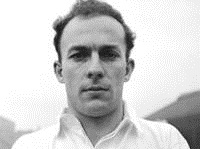
Eddie
Lowe |
Aston Villa FC
3 caps, 0 goals
P 3 W 2 D
0 L 1 F 13: A 1
67% successful
1947
disciplined: none
captaincies: none
minutes played: 270 |
|
 |
|
Profile |
|
Full name |
Edward Lowe |
|
name notes |
Edward, not Edmund - Birth Registration says so. |
|
Born |
11 July 1925 in Halesowen, Worcestershire [registered in
Stourbridge, September 1925]. |
|
Notes |
According
to passenger lists, Lowe was part
of a group of Fulham FC footballers that left Liverpool, bound for Quebec, on
15 May 1951, on board the Empress of Scotland, under the mastership of
E.A. Shergold. |
|
Died |
9 March 2009 in Nottingham,
aged
83 years 241 days. |
|
Height/Weight |
5'
11", 11st.
3lbs [1949]. |
|
Source |
Douglas Lammings' An
English Football Internationalist Who's Who [1990] & FindMyPast.com |
|
Club Career |
|
Club(s) |
While in
London, Lowe guested for the Napier Aircraft Company FC (Millwall) as an
amateur, and also played with Kynoch's FC (Birmingham). He represented
Finchley FC and Walthamstow Avenue FC briefly, before returning to the
Midlands. It was while playing with Kynoch's in a cup final that he was
discovered by Villa. Turning
professional in September 1945, Lowe soon broke into the first team,
104 league appearances followed and three goals, but results
suffered, as did holding down a place, so in May 1950, Lowe, along with
his younger brother Reg, were transferred to Fulham FC, both for �15,000.
In 1960, Lowe, who had been linked with a move to high-riding Tottenham
Hotspur. But after 473 league appearances for the cottagers, and
eight goals, Lowe accepted a new challenge, and in May 1963, he
accepted an offer to become player-manager of Third Division Notts County.
He did play nine times for them, but off-field decisions and lack of
progress, he was sacked in the spring of 1965.
|
|
Club honours |
Football
League South runners-up 1945-46; |
|
Individual honours |
Football
of the Year fourth place 1962-63 (as a 37 year old); |
|
Distinctions |
None |
|
Source |
Douglas Lammings' An English
Football Internationalist Who's Who [1990]. |
|
England Career |
|
Player number |
666th
player to appear for England. |
|
Position(s) |
Left-half |
|
First match |
No. 232, 3 May 1947, England 3
France 0, a friendly match at
Arsenal Stadium, Highbury, London, aged 21 years
296 days. |
|
Last match |
No. 234, 25 May 1947,
Portugal 0 England 10, an end-of-season tour match at
Estádio Nacional,
Jamor, Lisboa, aged 21 years 318 days. |
|
Major tournaments |
None |
|
Team honours |
None |
|
Individual honours |
None |
|
Distinctions |
None |
|
Beyond England |
|
As a teenager, Lowe found employment at
a tube-works in Birmingham, before moving to London to become an engineer
during the war. He
served as a "Bevin Boy" in Black Country coal
mines towards the end of the Second World War.
Still devoted to the game, Lowe scouted briefly for Plymouth
Argyle in 1965 while qualifying as an accountant, before earning his
livelihood as a purchasing manager for a boiler-making company in
Nottingham, where he lived for the rest of his life. - An
English Football Internationalists' Who's Who. Douglas Lamming (1990).
Hatton Press, p.160./Independent Obituary |
|
Eddie Lowe - Career Statistics |
|
Squads |
Apps |
Comp.
Apps |
Mins. |
Goals |
Goals
Av.min |
Comp.
Goals |
Capt. |
Disc. |
|
3 |
3 |
0 |
270 |
0 |
0
min |
0 |
None |
None |
|
Due to the fact that
many matches rarely stuck to exactly ninety minutes long, allowing time
for injuries, errors and substitutions. The minutes here
given can only ever be a guideline and cannot therefore be accurate, only
an approximation. |
|
Eddie Lowe
- Match Record - All Matches - By
Colour of Shirt - By Type of Match |
|
Type |
P |
W |
D |
L |
F |
A |
GD |
FTS
|
CS |
FAv |
AAv |
Pts
% |
W/L |
|
Home |
1 |
1 |
0 |
0 |
3 |
0 |
+3 |
0 |
1 |
3.00 |
0.00 |
100.0 |
+1 |
|
Away |
2 |
1 |
0 |
1 |
10 |
1 |
+9 |
1 |
1 |
5.00 |
0.50 |
50.0 |
=0 |
| All
- White - Friendly |
3 |
2 |
0 |
1 |
13 |
1 |
+12 |
1 |
2 |
4.333 |
0.333 |
66.7 |
+1 |
|
Eddie Lowe
- Match History |
|
Club: Aston
Villa F.C. - 3 full caps |
Coach: Walter
Winterbottom - 3
full capsx
|
|
|
Age 21 |
|
1 |
232 |
3 May 1947 -
England 3 France 0,
Arsenal Stadium, Highbury, London |
Fr |
HW |
Start |
6 |
|
2 |
233 |
18 May 1947 -
Switzerland 1 England 0,
Hardturm
Sportplatz, Zürich |
Tour |
AL |
Start |
6 |
|
3 |
234 |
25 May 1947 -
Portugal 0 England 10,
Estádio Nacional,
Jamor, Lisboa |
AW |
Start |
6 |
Notes
As a teenager, Lowe found employment
at a tube-works in Birmingham, before moving to London to become an
engineer during the war. While in the capital he guested for Millwall as
an amateur, and also represented Finchley and Walthamstow Avenue briefly,
before returning to the Midlands. It was while playing for his works side
in a cup final that he was discovered by Villa.
After turning professional in September 1945, Lowe, who served as a
"Bevin Boy" in Black Country coal mines towards the end of the Second
World War, soon broke into the first team. He helped his new employers to
finish as runners-up in the Football League South, an emergency wartime
competition, before becoming a regular when normal service was resumed.
So impressive was his form as Villa maintained a healthy presence in
the top half of the First Division that he earned that England call-up
against France, then took part in a 1-0 defeat in Switzerland and a 10-0
annihilation of Portugal in Lisbon � playing behind the sumptuous forward
line of Stanley Matthews, Stan Mortensen, Tommy Lawton, Wilf Mannion and
Tom Finney � in the space of three weeks.
However, he was overlooked when England returned to action in the
autumn, and then suffered a couple of niggling injuries. Meanwhile,
competition for Villa places heated up as the manager Alex Massie strove
to combat a slight downturn in results. Thus, in May 1950, Lowe, along
with his younger brother Reg, a left-back whose career was to be ended
prematurely by a broken leg, was transferred to fellow top-flight club
Fulham. Eddie's fee was reported as being �10,000, Reg's as �3,000.
At Craven Cottage Lowe instantly became a pillar of strength. But it
was a poor side he had joined and though relegation was avoided narrowly
in his first campaign, Fulham went down as the bottom club in 1951-52.
He proved to be a shrewd acquisition, though, emerging as a key
component of an attractively remoulded team in which the jewel was the
enchantingly gifted young inside-forward, Haynes. As the decade
progressed, Fulham entertained royally, aided by a free-flowing attack
containing the likes of inside-forwards Bobby Robson and Jimmy Hill,
winger Charlie Mitten and spearhead Bedford Jezzard. But it was not until
the arrival of Duggie Livingstone as manager in 1956 that a genuine belief
in the possibility of promotion began to grow.
In came high-quality additions such as the full-backs Jimmy Langley and
the future World Cup hero George Cohen, and the former England centre
forward Roy Bentley. In 1957-58 Fulham finished fifth in the Second
Division and reached the semi-finals of the FA Cup, bowing out only after
a replay to a Manchester United team recently ravaged by the Munich air
disaster, although Lowe missed that knock-out sequence through injury.
A season later, however, he was back exuding authority as Fulham, with
Jezzard newly installed as manager, finished runners-up to Sheffield
Wednesday, thus reclaiming their place among the elite. Lowe maintained a
steady presence as Fulham consolidated with a commendable 10th place in
1959-60, then embarked on a trio of successful battles against relegation
leavened by another run to the last four of the FA Cup in 1961-62.
By the spring of 1963, Lowe was approaching his 38th birthday, yet
could look back on a term in which he had finished fourth in the
Footballer of the Year poll. The coveted statuette went to an even more
gnarled campaigner: Stanley Matthews.
Lowe, who had been linked in the press with a move to high-riding
Tottenham Hotspur only 18 months earlier, was now at a crossroads. Instead
of attempting to soldier on in the top tier, he accepted an offer to
become player-manager of Third Division Notts County, bowing out of Craven
Cottage having played more times for the club than anyone except the icon
Haynes.
Sadly, the move didn't work out. Heavily criticised for his early sale
of the thrusting young marksman Tony Hateley to Aston Villa, and the
subsequent poor form of the replacement, Terry Bly, Lowe never truly
recovered. County, who were not financially well endowed, were demoted as
bottom club that term. He then sold another popular striker, Jeff Astle,
to West Bromwich Albion during the subsequent mediocre season in the
basement division. By then, in his 40th year and thus incapable of making
a meaningful impact on the field, he was sacked in the spring of 1965.
Still devoted to the game, Lowe scouted briefly for Plymouth Argyle
while qualifying as an accountant, before earning his livelihood as a
purchasing manager for a boiler-making company in Nottingham, where he
lived for the rest of his life. - The Independent Obituary
____________________
CG
|
|