|
|
|
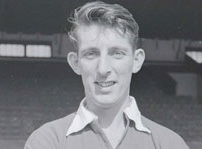
Laurie
Hughes |
Liverpool FC
3 appearances, 0 goals
P 3 W 1 D 0 L 2 F 2:
A 2
33%
successful
1949-50
captain: none
minutes played: 270 |
|
 |
|
Timeline |
| |
Laurie Hughes |
|
Birth |
2 March 1924 in Waterloo, Liverpool, Lancashire [registered as
Laurie, in
West Derby, June 1924]. |
|
|
Hughes
appeared on several passenger lists. Firstly, he was on the Queen Mary,
that had left Southampton, bound for New York under the mastership of C.M.
Ford, on 4 May 1946, along with other members of Liverpool FC.
Again,
Hughes was on board the Queen Elizabeth, leaving Southampton for New York,
under the mastership of G.E. Care, on 7 May 1948, along with other members
of Liverpool FC.
Finally, Hughes was back on the Queen Mary, leaving
Southampton for New York on 6 May 1953, under the mastership of C.I.
Thompson, along with other members of Liverpool FC. His address was stated
as 22 Bulcher Street in Liverpool. |
|
Marriage |
to Mildred
Shacklady
[registered in Corby, Lancashire, September 1954]. |
|
Death |
9 September
2011 in Liverpool, aged
87 years 191 days |
|
Source |
 Douglas Lammings' An
English Football Internationalist Who's Who [1990] & Douglas Lammings' An
English Football Internationalist Who's Who [1990] & |
|
Biographies |
x |
| |
x.
- A Football Compendium, Peter J. Seddon (1999). |
|
Club Career |
|
Club(s) |
x |
|
Club honours |
x |
|
Individual honours |
x |
|
Distinctions |
x |
|
Height/Weight |
6'
0", 12st.
4lbs [1950]. |
|
Source |
Douglas Lammings' An English
Football Internationalist Who's Who [1990]. |
|
England Career |
|
Player number |
694th
player to appear for England. |
|
Position(s) |
Centre-half |
|
First match |
No. 256, 25 June 1950, England 2 Chile
0, a World Cup Finals group match at Estádio
Municipal, Maracanã, Rio de Janeiro, aged 26 years 115 days. |
|
Last match |
No. 258, 2 July 1950, Spain 1 England 0,
a World Cup Finals group match at Estádio
Municipal, Maracanã, Rio de Janeiro, aged 26 years 122 days. |
|
Major tournaments |
World Cup
Finals 1950; |
|
Team honours |
None |
|
Individual honours |
England B
(one appearance, January 1950) |
|
Distinctions |
First player to
make his England debut at a Major Tournament Final.
All his three
appearances were at a Major Tournament Final. |
|
Beyond England |
|
x. -
An English Football Internationalists' Who's Who.
Douglas Lamming (1990). Hatton Press, p.x. |
|
The Numbers |
|
parties |
Appearances |
comp. apps |
reserve |
minutes |
 |
captain |
|
3 |
3 |
3 |
1 |
270 |
0 |
none |
|
minutes are an approximation, due to the fact that many matches rarely stick to exactly ninety minutes long, allowing time for injuries and errors. |
|
P |
W |
D |
L |
F |
A |
GD |
FTS
|
CS |
FAv |
AAv |
Pts% |
W/L |
|
3 |
1 |
0 |
2 |
2 |
2 |
=0 |
2 |
1 |
0.667 |
0.667 |
33.3 |
-1 |
|
all his matches were played on a neutral venue and are World Cup
Final matches |
Shirt Record
|
Colour |
P |
W |
D |
L |
F |
A |
GD |
FTS
|
CS |
FAv |
AAv |
Pts% |
W/L |
|
White |
2 |
1 |
0 |
1 |
2 |
1 |
+1 |
1 |
1 |
1.00 |
0.50 |
50.0 |
=0 |
|
Blue |
1 |
0 |
0 |
1 |
0 |
1 |
-1 |
1 |
0 |
0.00 |
1.00 |
0.00 |
-1 |
Tournament Record
|
World Cup Final Tournament |
|
Type |
P |
W |
D |
L |
F |
A |
GD |
FTS |
CS |
FAv |
AAv |
Pts% |
W/L |
|
WCF 1950 |
3 |
1 |
0 |
2 |
2 |
2 |
=0 |
2 |
1 |
0.667 |
0.667 |
33.3 |
-1 |
|
WCF
All |
3 |
1 |
0 |
2 |
2 |
2 |
=0 |
2 |
1 |
0.667 |
0.667 |
33.3 |
-1 |
|
All Competition |
|
Type |
P |
W |
D |
L |
F |
A |
GD |
FTS |
CS |
FAv |
AAv |
Pts% |
W/L |
|
WCF |
3 |
1 |
0 |
2 |
2 |
2 |
=0 |
2 |
1 |
0.667 |
0.667 |
33.3 |
-1 |
|
3 |
1 |
0 |
2 |
2 |
2 |
=0 |
2 |
1 |
0.667 |
0.667 |
33.3 |
-1 |
Match History
|
Club:
Liverpool F.C. - three full appearances (270 min) |
manager: Walter
Winterbottom - three full appearances (270 min)x
|
|
apps |
match |
pic |
match details |
comp |
res. |
rundown |
shirt |
|
|
 England
Football Online
England
Football Online