England Football Online
 Home  New Team Matches
Seasons Competition  Opponents Comment
Features Q & A Forum Appendices
Contact Us Page Last Updated 7 July 2002


England in World Cup 2002
Final Tournament


World Cup 2002 Final Tournament
31 May to 30 June in Japan and South Korea

First Phase Group F Table
Team P W D L F A GD Pts
Sweden 3 1 2 0 4 3 +1 5
England 3 1 2 0 2 1 +1 5
Argentina 3 1 1 1 2 2 =0 4
Nigeria 3 0 1 2 1 3 -2 1


First Phase Group F Matches
Date Match Score H.T. Venue Attendance
02-Jun-2002 Argentina 1 Nigeria 0 [0-0] Ibaraki Prefectural Kashima Soccer Stadium, Kashima City, Ibaraki, Japan 34,050
02-Jun-2002 England 1 Sweden 1 [1-0] Saitama Stadium 2002, Saitama-ken, Japan  52,721
07-Jun-2002 Sweden 2 Nigeria 1 [1-1] Kobe Wing Stadium, Kobe City, Japan 36,194
07-Jun-2002 Argentina 0 England 1 [0-1] Sapporo Dome, Sapporo City, Japan 35,927
12-Jun-2002 Sweden 1 Argentina 1 [0-0] Miyagi Stadium, Miyagi, Japan 45,777
12-Jun-2002 Nigeria 0 England 0 [0-0] Nagai Stadium, Osaka City, Japan 44,864

Notes

[To come.]

Second Phase Matches
Round of 16 Matches
Date Match Score H.T. Venue Attendance
15-Jun-2002 Germany 1 Paraguay 0 [0-0] Jeju World Cup Stadium, Seogwipo-si, South Korea 25,176
15-Jun-2002 Denmark 0 England 3 [0-3] Niigata Prefectural Stadium ("Big Swan"), Niigata-city, Japan 40,582
16-Jun-2002 Sweden 1 Senegal 2 [1-1] Oita Stadium ("Big Eye"), Oita City, Japan 39,747

1-1 full-time, 2-1 on golden goal in 14th min. extra time

16-Jun-2002 Spain 1 Republic of Ireland 1 [1-0] Suwon World Cup Stadium, Suwon-si, South Korea 38,926

1-1 full-time, 1-1 after extra time, 3-2 penalty kicks

17-Jun-2002 México 0 U.S.A. 2 [0-1] Jeonju World Cup Stadium, Jeonju-si, South Korea 36,380
17-Jun-2002 Brazil 2 Belgium 0 [0-0] Kobe Wing Stadium, Kobe City, Japan 40,440
18-Jun-2002 Japan 0 Turkey 1 [0-1] Miyagi Stadium, Miyagi, Japan 45,666
18-Jun-2002 Korea Republic 2 Italy 1 [0-1] Daejeon World Cup Stadium, Daejeon, South Korea 38,588

1-1 full-time, 2-1 on golden goal in 27th min. extra time

Quarterfinal Matches

Date Match Score H.T. Venue Attendance
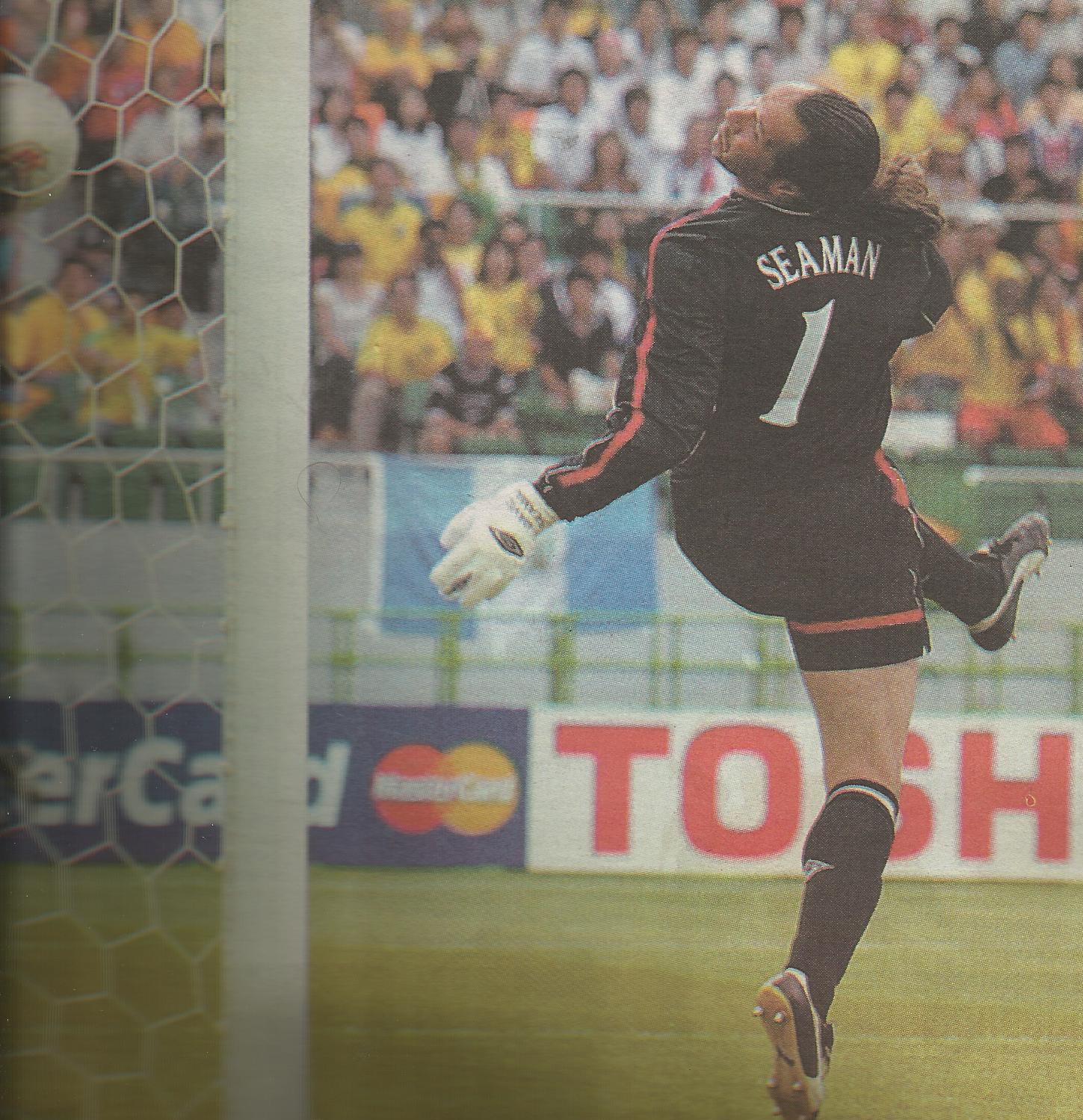
21-Jun-2002 England 1 Brazil 2 [1-1] Shizuoka Stadium Ecopa, Fukuroi City, Japan 47,436
21-Jun-2002 Germany 1 U.S.A. 0 [1-0] Ulsan Munsu Football Stadium, Yokohama City, South Korea 37,337
22-Jun-2002 Spain 0 Korea Republic 0 [0-0] Gwangju World Cup Stadium, Gwangju, South Korea 42,114

0-0 full-time, 0-0 after extra time, 3-5 penalty kicks

22-Jun-2002 Senegal 0 Turkey 1 [0-0] Nagai Stadium, Osaka City, Japan 44,233

0-0 full-time, 0-1 on golden goal in 4th min. extra time

Semifinal Matches

Date Match Score H.T. Venue Attendance
25-Jun-2002 Germany 1 Korea Republic 0 [0-0] Seoul World Cup Stadium, Seoul, South Korea 65,625
26-Jun-2002 Brazil 1 Turkey 0 [0-0] Saitama Stadium 2002, Saitama-ken, Japan 61,058

Third Place Match

Date Match Score H.T. Venue Attendance
29-Jun-2002 Korea Republic 2 Turkey 3 [1-3] Daegu World Cup Stadium, Daegu, South Korea 63,483
Final Match
Date Match Score H.T. Venue Attendance
30-Jun-2002 Germany 0 Brazil 2 [0-0] Yokohama International Sports Stadium, Yokohama City, Japan 69,029

Notes

[To come.]

Background

FIFA's World Cup 2002 Organising Committee divided the 32 qualifying teams into eight groups for the final tournament at the World Cup Final Draw, held on 1 December 2001 in Busan, South Korea.  

Three days ahead of the draw, on 28 November 2001, the Organising Committee announced the method by which it would be conducted.

The Committee decided France, as reigning World Cup champion, and South Korea and Japan, as host nations, would be seeded as three of the top eight teams and assigned them to head Groups A, D and H, respectively.  To determine the other five seeded teams, the Committee used a complex formula to rank all 32 teams on the basis of their performance in the last three World Cup final tournaments and their standing in FIFA's world rankings for the last three years.  The top five teams in this ranking (apart from the already-seeded France, which placed 5th) were Brazil, Argentina, Italy, Germany and Spain, and they joined the other three as seeded teams.  These five teams were placed in Pot 1 for the draw. 

The 11 remaining teams qualifying from UEFA--Belgium, Croatia, Denmark, England, Republic of Ireland, Poland, Portugal, Russia, Slovenia, Sweden and Turkey--were put in Pot 2.  

The remaining three CONMEBOL teams--Ecuador, Paraguay and Uruguay--and the other two AFC teams--China and Saudi Arabia--were placed in Pot 3.  The Committee granted China's request for assignment to one of the South Korea groups, apparently made because of prohibitive lodging costs in Japan, and at the same time decided Saudi Arabia would be allocated to one of the Japan groups.

The five CAF and three CONCACAF teams--Cameroon, Nigeria, Senegal, South Africa, Tunisia, Costa Rica, México and U.S.A.--were put in Pot 4.

Two factors complicated the draw.  One was FIFA's customary principle that "teams from the same confederation shall not be placed in the same group as far as possible," with "[t]he only exception" being that "a maximum of 2 teams from UEFA may be drawn into the same group, due to the higher number of teams from Europe."  The other factor--dual hosts for the first time in the tournament's history--made the draw, always complex, worse than ever, as FIFA Executive Secretary Michel Zen-Ruffinen told the worldwide television audience.  The Committee decided that "the co-hosting situation (groups A to D in Korea, groups E to H in Japan) will be taken into account when placing the teams into the respective groups by ensuring that there is a balance of each confederation['s] teams in Korea and Japan."

These two principles determined the procedures the Committee adopted for the draw.  First, the five unassigned seeded teams were selected one by one from Pot 1 and allocated to head Groups B, C, E, F and G in order while ensuring that one CONMEBOL team would be assigned to South Korea and one to Japan.  Second, as each unseeded team was drawn from Pots 2, 3 and 4 and assigned to a group, its position in the group (2, 3 or 4) was also determined by draw.  Third, eight UEFA teams were drawn from Pot 2 and assigned to Groups A to H in order.  Fourth, the remaining three UEFA teams were drawn and assigned to groups not already containing two UEFA teams by virtue of a parallel draw from Special Pot i, which contained the four seeded non-UEFA teams.  Fifth, the five teams from Pot 3 were drawn and assigned to the other five groups while ensuring that at least one CONMEBOL and one AFC team were allocated to both South Korea and Japan.  Sixth, the teams from Pot 4 were drawn and assigned to groups A to H in order while ensuring that at least two CAF teams and one CONCACAF team were allocated to both South Korea and Japan.

The draw produced the following groups:

Groups in South Korea
Group A Group B Group C Group D
A1 France B1 Spain C1 Brazil D1 South Korea
A2 Senegal B2 Slovenia C2 Turkey D2 Poland
A3 Uruguay B3 Paraguay C3 China D3 U.S.A.
A4 Denmark B4 South Africa C4 Costa Rica D4 Portugal
Groups in Japan
Group E Group F Group G Group H
E1 Germany F1 Argentina G1 Italy H1 Japan
E2 Saudi Arabia F2 Nigeria G2 Ecuador H2 Belgium
E3 Republic Ireland F3 England G3 Croatia H3 Russia
E4 Cameroon F4 Sweden G4 México H4 Tunisia

Notes

England placed 8th in the Organising Committee's special World Cup team ranking, just below México and two rungs below Spain, the lowest seeded team, but far above the two seeded host nations South Korea, 25th, and Japan, 26th.  Only because the host nations were seeded did England fail to gain seeded status.  Seeding host nations above teams ranking much higher on the basis of performance is, of course, a highly dubious practice, since there are other methods available to assure host nations play at particular venues.  It is a practice that may cost England dearly in this tournament.

The assignment of England to Group F, which already contained Argentina from seeded Pot 1 and Sweden from UEFA Pot 2, drew the only collective gasp of the evening from the live audience.  Not only would Sven-Goran Eriksson lead England against his native Sweden on the group's opening match day, but England would renew their often bitter World Cup rivalry with Argentina.  

Nigeria from Pot 4 completed the Group F.  The media promptly tagged it the proverbial "Group of Death," and the bookmakers' odds on England winning the World Cup immediately plummeted from 7 or 8 to 1 to 1 to 10 to 1.

Group F is, indeed, formidable.  It is, in fact, by far the most difficult group in the tournament.   Argentina, 2nd in both FIFA's world rankings and the Organising Committee's World Cup ranking and the bookmakers' favourite to win the tournament, dominated the single qualifying group for South American teams.  Sweden, 16th in the world rankings and 13th in the World Cup ranking, finished with the best qualifying record of any European team.  Nigeria, only 40th in the world rankings but 18th in the World Cup ranking, has World Cup experience and can hardly be dismissed as a threat.

England will have no time to settle in when play begins.  In the supercharged pressure of the World Cup finals, that may prove an insurmountable difficulty for a team that is young and inexperienced in key positions.

Two of the three teams in the group have proven particularly difficult for England in recent meetings.  England have not beaten Sweden in nine matches since their last win in 1968, at Wembley, and they have lost three of those nine, including the group match that put them out of the European Championship 1992 final tournament in Sweden and the opening match in their European Championship 2000 qualifying campaign.   

Nor have England beaten Argentina in four matches since their last victory in 1980 at Wembley.  Although Argentina won only one of these four, the World Cup 1986 quarterfinal in México City when they benefitted from Diego Mardona's "Hand of God" goal, they also put England out of World Cup 1998 on penalty kicks following the celebrated 2-2 extra-time draw in which David Beckham was shown the red card.

England have little experience with Nigeria.  They met once, in a friendly at Wembley in late 1994, when England managed to win, 1-0.  But Nigeria are capable of the kind of football with which South American teams have often troubled England.

Even more foreboding are the prospects for teams advancing from Group F.  In the tournament's second stage, the round of 16 teams, the winner of Group F will face the second-place team from Group A, and the second-place team from Group F will meet the winner of Group A.  Among the teams in Group A, of course, is reigning World Cup and European champion France.  Even if France are overcome, the quarterfinal opponent will likely be Brazil.

Further Information

The first match of the final tournament will be played on 31 May 2002 in Seoul and the final match on 30 June in Yokohama.  The official FIFA World Cup 2002 website lists all the final tournament fixtures.

___________________

PY